
Customer Relationship Management:
Complete Guide for Businesses
Customer relationship management is the backbone of every successful business, whether you are a solo entrepreneur managing your first handful of clients or a growing company overseeing hundreds of accounts. At its core, CRM is about building meaningful connections with the people who drive your revenue. It encompasses the strategies, processes, and technology that help you attract new leads, nurture them through a structured sales pipeline, convert them into loyal customers, and continue delivering value long after the initial sale. In a marketplace where buyers have more choices than ever, the businesses that win are the ones that remember every interaction, respond promptly to inquiries, and anticipate what their customers need next. This guide explores everything you need to know about customer relationship management, from its historical roots and different types to the practical benefits it delivers and how Timeline CRM brings these principles to life in a free, offline desktop application.
Developed By
Timeline Digital Solutions
For customized software or apps, contact Timeline Digital Solutions. We build practical business software, CRM systems, and tailored digital tools for real-world business operations.
Table of Contents
- 1. What Is Customer Relationship Management?
- 2. The History and Evolution of CRM
- 3. Types of CRM: Operational, Analytical, and Collaborative
- 4. Key Benefits of CRM for Businesses
- 5. Essential Features of a CRM System
- 6. How Timeline CRM Implements CRM Principles
- 7. Timeline CRM Module Overview
- 8. Frequently Asked Questions
What Is Customer Relationship Management?
Customer relationship management refers to the combination of strategies, practices, and technologies that organizations use to manage and analyze customer interactions throughout the entire customer lifecycle. The goal is straightforward: improve business relationships, retain existing customers, and drive new sales growth. CRM as a discipline goes beyond simply storing contact information in a database. It involves understanding customer behavior, tracking communication history, identifying sales opportunities, and creating consistent experiences across every touchpoint.
In practical terms, a CRM system acts as a centralized hub where all customer-related data lives. When a new lead fills out a contact form, that information is captured and assigned a stage in the sales pipeline. As conversations happen, meetings are scheduled, and proposals are sent, every detail is recorded against that lead's profile. When the lead converts into a customer, their complete history moves with them, giving you full context for every future interaction. This level of organization eliminates the chaos of scattered spreadsheets, missed follow-ups, and forgotten conversations that plague businesses without a proper CRM system in place.
Modern CRM solutions serve businesses of every size. Enterprise organizations use platforms like Salesforce and Microsoft Dynamics to manage millions of customer records across global teams. Small businesses and independent professionals increasingly rely on lightweight, accessible CRM tools that deliver core functionality without the complexity and cost of enterprise systems. Timeline CRM falls into this category, providing a full-featured CRM experience through a free desktop application built specifically for Windows.
The History and Evolution of CRM
The concept of managing customer relationships is not new. Businesses have always recognized the value of knowing their customers personally. In the pre-digital era, shopkeepers kept mental notes about their regulars' preferences, and salespeople maintained handwritten Rolodex cards with client details. The real transformation began in the 1980s when database marketing emerged, allowing companies to store and segment customer information electronically for the first time. This period laid the groundwork for what would eventually become the CRM industry.
The 1990s marked the birth of dedicated CRM software. Companies like Siebel Systems, GoldMine, and ACT! created applications that combined contact management with sales force automation. These early CRM tools were installed on individual computers or company servers, and they introduced concepts like pipeline stages, activity logging, and opportunity tracking that remain fundamental to CRM systems today. The software was expensive and complex, limiting adoption to larger corporations with dedicated IT departments.
The most significant shift came in 1999 when Salesforce launched its cloud-based CRM platform, proving that business software could be delivered over the internet as a subscription service. This model made CRM accessible to smaller organizations and spawned an entire industry of cloud-based CRM providers including HubSpot, Zoho, Pipedrive, and Freshsales. Today, the CRM market continues to evolve with desktop applications like Timeline CRM offering a return to local-first computing, combining the rich functionality of modern CRM with the simplicity, privacy, and offline reliability of installed software.
Types of CRM: Operational, Analytical, and Collaborative
CRM systems are commonly classified into three distinct types based on their primary function. Understanding these categories helps businesses choose the right CRM approach for their specific needs and goals. Many modern CRM platforms, including Timeline CRM, blend elements from multiple types to deliver a well-rounded experience.
Operational CRM focuses on automating and improving the day-to-day processes that directly involve customer interactions. This includes sales automation features like lead scoring, pipeline management, and deal tracking. It also covers service automation through ticket management and support workflows, as well as marketing automation through campaign tracking and lead nurturing sequences. The primary benefit of operational CRM is efficiency. By automating repetitive tasks, sales teams spend less time on data entry and more time on selling. Timeline CRM is primarily an operational CRM, providing structured pipelines for leads and deals, automated task management, and document generation for quotations and invoices.
Analytical CRM concentrates on gathering, organizing, and interpreting customer data to uncover actionable insights. This type of CRM helps businesses understand purchasing patterns, identify high-value customer segments, evaluate sales team performance, and forecast future revenue. Analytical CRM relies heavily on dashboards, reports, and data visualization tools. Timeline CRM includes analytical capabilities through its Reports and Analytics module, which provides performance dashboards, lead conversion metrics, and revenue tracking to help users make data-driven decisions.
Collaborative CRM emphasizes information sharing and communication across different departments and external stakeholders. The goal is to ensure that everyone involved in the customer relationship has access to the same data and can contribute to a seamless customer experience. Collaborative CRM is especially important for organizations where sales, marketing, and support teams need to work in close coordination. While Timeline CRM is designed as a single-user desktop application, its integrated module structure ensures that all customer-related data, from initial lead capture through invoicing, is accessible in one unified workspace.
Key Benefits of CRM for Businesses
Implementing customer relationship management delivers tangible benefits that directly impact revenue, efficiency, and customer satisfaction. The most immediate benefit is centralized data organization. When every lead, customer, deal, and interaction is stored in one place, you eliminate the information silos that cause miscommunication and missed opportunities. Instead of searching through email threads, sticky notes, and spreadsheet tabs, you can pull up a complete customer profile in seconds.
CRM systems also dramatically improve lead conversion rates. With a structured sales pipeline, you can see exactly where every lead stands in the buying process, identify which leads need follow-up, and prioritize your efforts on the opportunities most likely to close. Studies consistently show that businesses using CRM software close deals faster and at higher rates than those relying on informal tracking methods. Timeline CRM's seven-stage lead pipeline and six-stage deal pipeline provide this structure at no cost.
Beyond sales performance, CRM improves operational efficiency by automating administrative tasks. Generating quotes, creating invoices, tracking payments, managing products, and scheduling follow-up tasks are all activities that consume hours of manual effort each week when done without proper tools. A well-designed CRM automates or streamlines these workflows, freeing you to focus on the high-value activities that actually grow your business. Additionally, CRM reporting provides visibility into your business health, showing you which lead sources perform best, which deal stages create bottlenecks, and how your revenue trends over time.
Essential Features of a CRM System
Not all CRM systems are equal, and the features they include vary widely depending on the provider and pricing tier. However, there are certain core capabilities that every effective CRM should offer. Contact and lead management is the foundation. You need the ability to store detailed profiles for every prospect and customer, including contact details, communication history, and associated records like deals and invoices.
Sales pipeline management is equally critical. A visual pipeline, ideally presented as a Kanban board, lets you drag leads and deals between stages, giving you an instant overview of your sales funnel at any point in time. Task management ensures that follow-up activities are scheduled, tracked, and completed on time. Without task management built into your CRM, important actions fall through the cracks and potential revenue is lost.
Document generation capabilities, specifically quotations and invoices, are increasingly expected in modern CRM platforms. The ability to create professional proposals with line items, tax calculations, and company branding and then convert accepted quotations directly into invoices saves significant time and reduces errors. Reporting and analytics round out the essential feature set, providing dashboards and metrics that help you monitor performance and make informed decisions. Timeline CRM includes every one of these features across its eleven integrated modules, delivering enterprise-grade CRM capability in a free desktop package.
How Timeline CRM Implements Customer Relationship Management Principles
Timeline CRM was designed from the ground up to embody the core principles of customer relationship management in a practical, accessible application. Built by Timeline Digital Solutions using Electron, React, and SQLite, it runs natively on Windows 10 and Windows 11 as a 64-bit desktop application. Every module in the system is purpose-built to address a specific aspect of the customer relationship lifecycle, and all modules connect seamlessly to create a cohesive CRM experience.
The customer journey in Timeline CRM begins in the Leads module, which provides a seven-stage Kanban pipeline for tracking prospects from initial contact through to qualification. When a lead is ready to move forward, it can be converted into a customer record and associated deal. The Deals module offers its own six-stage pipeline for managing active sales opportunities with full visibility into expected revenue and closing timelines. Throughout this process, the Tasks module ensures that every follow-up action, phone call, meeting, and deadline is tracked and completed.
Once a deal progresses to the proposal stage, Timeline CRM's Quotations module generates professional documents with automatic numbering, line items from the Products module, tax calculations, and PDF export. When a quotation is accepted, it converts into an invoice with payment tracking capabilities. The Reports and Analytics module ties everything together by providing performance dashboards that reveal lead sources, conversion rates, revenue trends, and pipeline health. This end-to-end workflow demonstrates how Timeline CRM delivers on the fundamental promise of customer relationship management: organizing every aspect of your customer interactions in one unified system.
Timeline CRM Module Overview
Every module you need for complete customer relationship management, available for free in one desktop application.
Dashboard
Centralized overview of your entire CRM with key metrics, recent activities, and performance indicators at a glance.
Leads Management
Seven-stage Kanban pipeline for tracking prospects from initial contact through qualification with drag-and-drop simplicity.
Customer Database
Comprehensive customer profiles with contact details, communication history, linked deals, quotations, and invoices.
Deal Pipeline
Six-stage deal tracking pipeline with expected values, closing dates, and conversion progress for every active opportunity.
Tasks & Activities
Schedule and track follow-ups, calls, meetings, and deadlines to ensure no customer interaction falls through the cracks.
Reports & Analytics
Performance dashboards, lead conversion metrics, revenue tracking, and business intelligence to guide data-driven decisions.
Frequently Asked Questions About Customer Relationship Management
Everything you need to know about CRM and how Timeline CRM delivers it for free.
What is customer relationship management? ▾
Customer relationship management, commonly abbreviated as CRM, is a strategy and set of practices that businesses use to manage interactions with current and potential customers. It involves using technology to organize, automate, and synchronize sales, marketing, customer service, and technical support activities. CRM systems store customer data in a centralized location and provide tools for tracking every touchpoint throughout the customer lifecycle.
What are the three main types of CRM? ▾
The three main types of CRM are operational, analytical, and collaborative. Operational CRM focuses on streamlining day-to-day customer-facing processes such as sales automation, marketing campaigns, and service management. Analytical CRM concentrates on collecting and analyzing customer data to identify patterns and make better business decisions. Collaborative CRM emphasizes communication and information sharing across departments and with external partners to deliver a unified customer experience.
Why is customer relationship management important for small businesses? ▾
Customer relationship management is especially important for small businesses because it helps them compete with larger organizations by providing structured processes for managing leads and customers. A CRM system eliminates the need for scattered spreadsheets, reduces the risk of losing important customer information, and ensures that follow-ups happen on time. For small businesses with limited staff, CRM automation saves hours of manual work each week and helps convert more leads into paying customers.
Is Timeline CRM a true customer relationship management system? ▾
Yes, Timeline CRM is a complete customer relationship management system that covers all essential CRM functions. It includes lead management with a seven-stage Kanban pipeline, customer database management, deal tracking with a six-stage pipeline, task management, product catalogs, quotation and invoice generation, and comprehensive reporting. All of these modules work together to provide a full CRM experience, and the entire application is available for free as a desktop download for Windows.
Can I use CRM software without an internet connection? ▾
Most cloud-based CRM platforms require a constant internet connection to function. However, desktop CRM solutions like Timeline CRM operate entirely offline. Timeline CRM stores all data locally in a SQLite database on your computer, which means you can manage contacts, update deal stages, create invoices, and generate reports without any internet connectivity. This is particularly useful for professionals who work in the field or in areas with unreliable internet access.
What is the difference between CRM software and a contact management app? ▾
A contact management app typically stores names, phone numbers, and email addresses in a simple database. CRM software goes far beyond contact storage by providing tools for tracking interactions, managing sales pipelines, automating follow-ups, generating business documents, and analyzing performance data. Timeline CRM, for example, includes eleven integrated modules that cover the entire customer journey from initial lead capture through invoicing and payment tracking, which is significantly more comprehensive than basic contact management.
How has customer relationship management evolved over the years? ▾
Customer relationship management has evolved from simple paper-based Rolodex systems in the 1950s to sophisticated digital platforms. The 1980s saw the introduction of database marketing, the 1990s brought the first dedicated CRM software from companies like Siebel Systems, and the 2000s ushered in cloud-based CRM with Salesforce leading the charge. Today, modern CRM solutions range from enterprise cloud platforms to lightweight desktop applications like Timeline CRM, which brings full CRM capability to individual professionals and small teams at no cost.
What features should a good CRM system include? ▾
A good CRM system should include contact and lead management, sales pipeline tracking, task and activity management, reporting and analytics, and document generation capabilities such as quotations and invoices. Advanced features to look for include customizable pipelines, product catalogs, search and filter tools, and data export options. Timeline CRM includes all of these features across its eleven modules, making it one of the most feature-complete CRM solutions available at any price point.
Experience Customer Relationship Management Done Right
Download Timeline CRM today and discover how a free, offline CRM can transform the way you manage customer relationships. No subscriptions, no limits, no internet required.
Download Timeline CRM FreeRelated Pages
Customer Management System
Learn how to organize and manage your customer database effectively.
Free CRM Software
Discover why Timeline CRM is the best free CRM for small businesses.
Best CRM Software
Compare top CRM solutions and find the right fit for your business.
Timeline CRM Features
Explore all eleven modules included in Timeline CRM for free.
Every Feature You Need,
Zero Cost
Timeline CRM packs a complete suite of business management tools into one free desktop application. From lead capture to invoice generation, every module is designed to help small businesses operate more efficiently without paying for expensive cloud subscriptions.
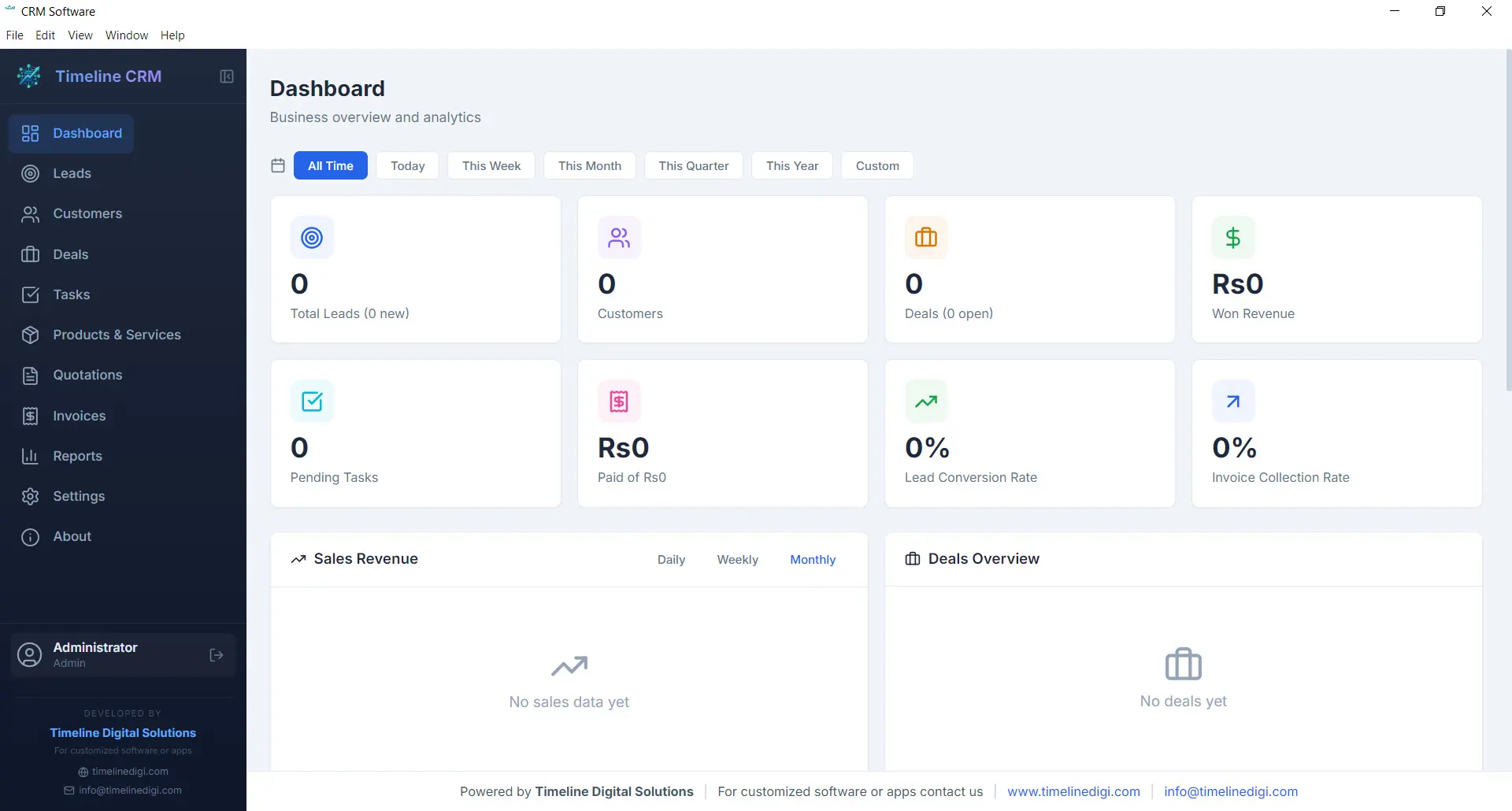
Dashboard
The Dashboard is your command center. Every time you open Timeline CRM, you are greeted with a comprehensive overview of your business performance. Key metrics are displayed prominently so you can gauge the health of your sales pipeline, track revenue trends, and identify areas that need attention — all without clicking through multiple screens.
Visual charts and summary cards present your data in an easy-to-digest format. Whether you want to see how many new leads came in this week, what your total deal value looks like, or which tasks are overdue, the Dashboard surfaces that information instantly. It is the first thing you see and the fastest way to stay on top of your business.
- Real-time business metrics and KPI cards
- Sales pipeline distribution chart
- Recent activity feed and upcoming tasks
- Revenue and lead trend visualizations
Leads
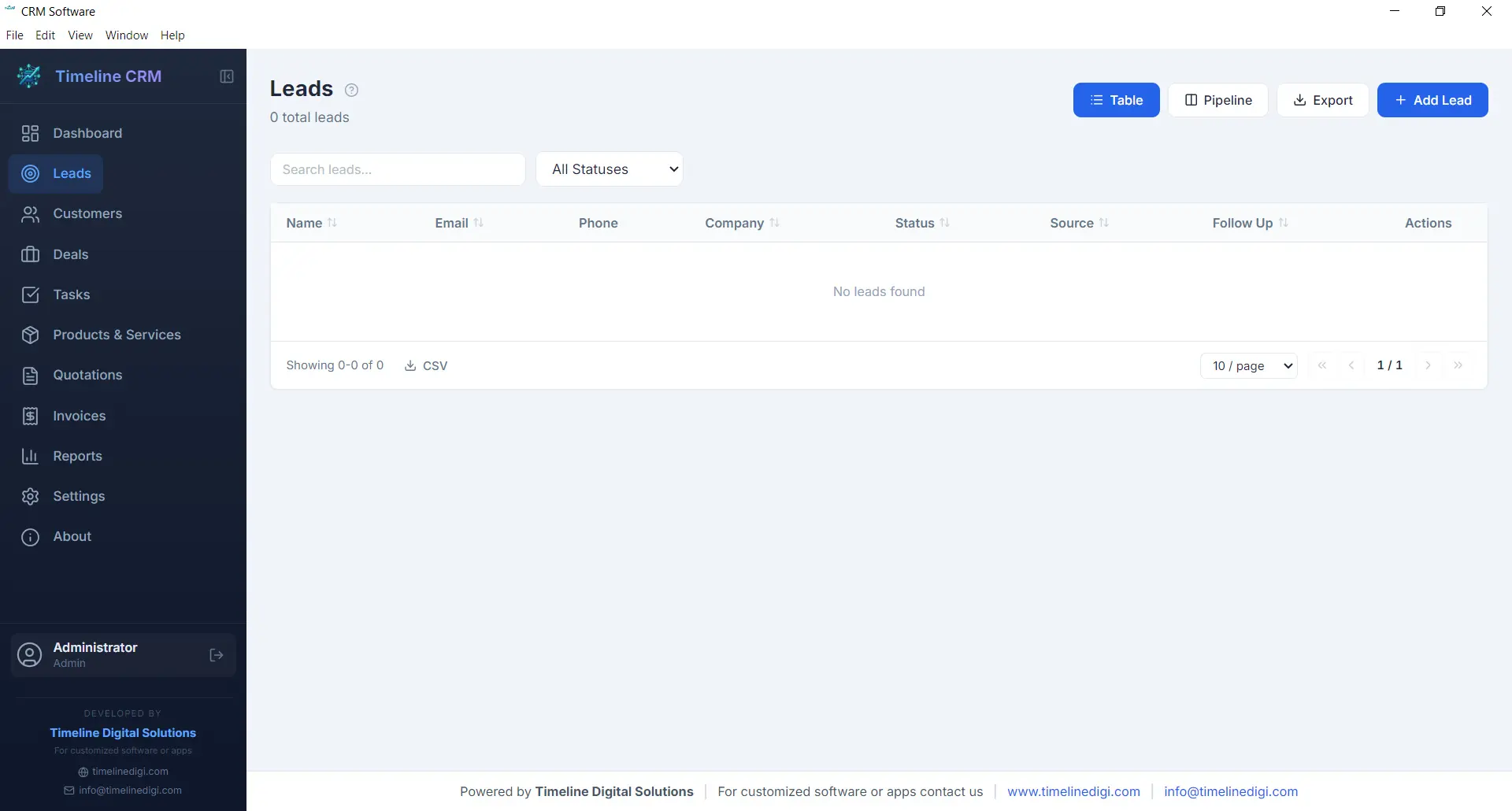
The Leads module is where every potential customer relationship begins. Capture new leads with detailed contact information, company details, and source tracking. Each lead is placed into a structured seven-stage pipeline — New, Contacted, Qualified, Proposal, Negotiation, Won, and Lost — so you always know exactly where every prospect stands in your sales process.
As you work with each lead, you can log phone calls, record meeting notes, attach documents, and track every interaction. This complete history ensures that no context is lost when you follow up days or weeks later. The pipeline view gives you a visual representation of your entire lead funnel, making it easy to spot bottlenecks and prioritize your outreach efforts.
- Seven-stage pipeline: New, Contacted, Qualified, Proposal, Negotiation, Won, Lost
- Call logging with date, duration, and notes
- Lead source and priority tracking
- Convert leads to customers with one click
Customers
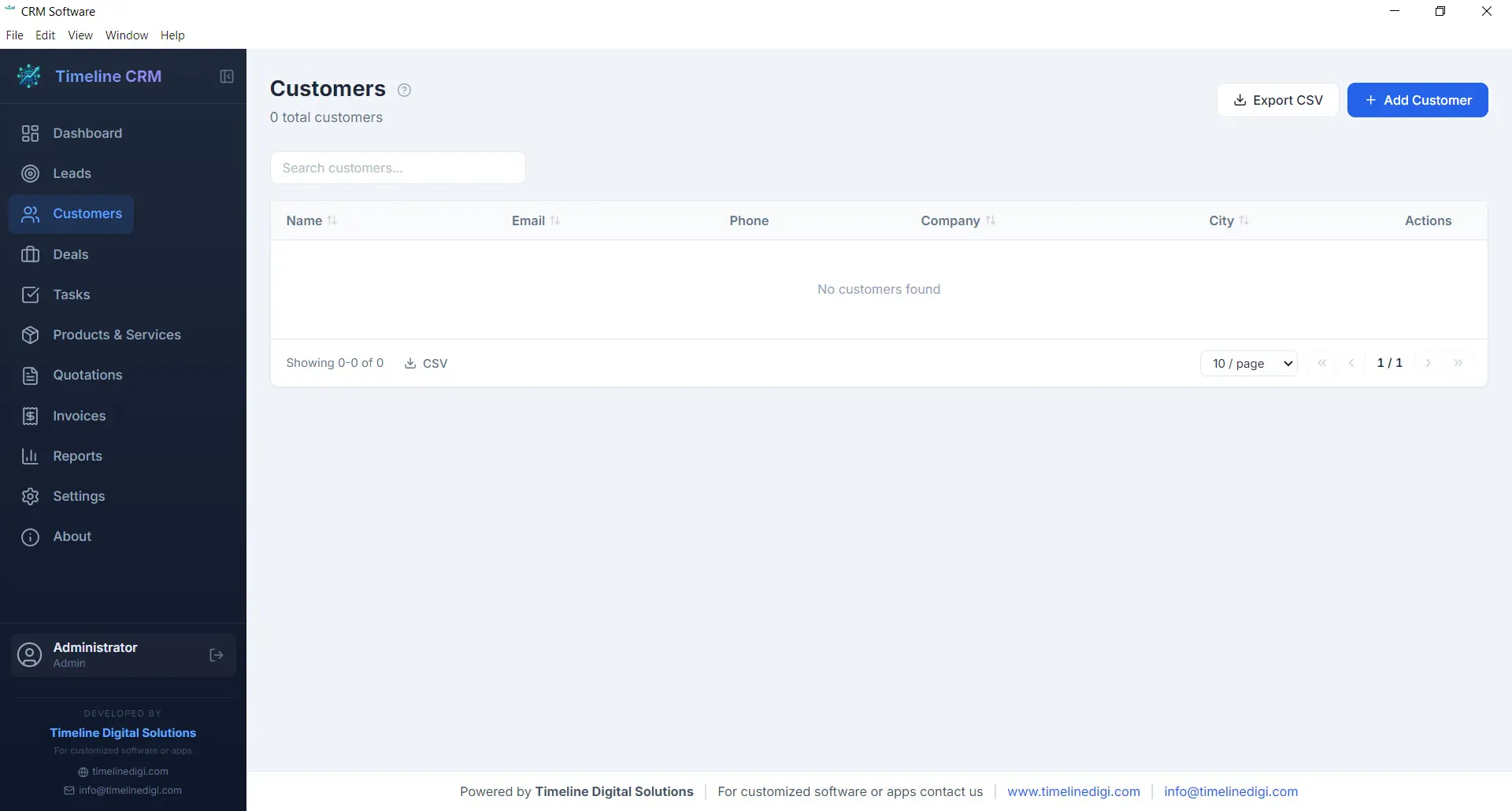
Your customers are the backbone of your business, and the Customers module helps you manage every relationship with care. Store comprehensive contact information, company details, billing addresses, and communication preferences in one organized record. When a lead is converted to a customer, all their history transfers automatically so nothing is lost in the transition.
Each customer profile acts as a hub connecting all related business data. Open any customer record and you can instantly view their associated deals, outstanding invoices, past quotations, and every note or interaction logged over time. This 360-degree view enables you to provide better service, anticipate needs, and build long-term relationships that drive repeat business.
- Complete contact and company profiles
- Full interaction and transaction history
- Linked deals, invoices, and quotations
- CSV export for customer data
Deals
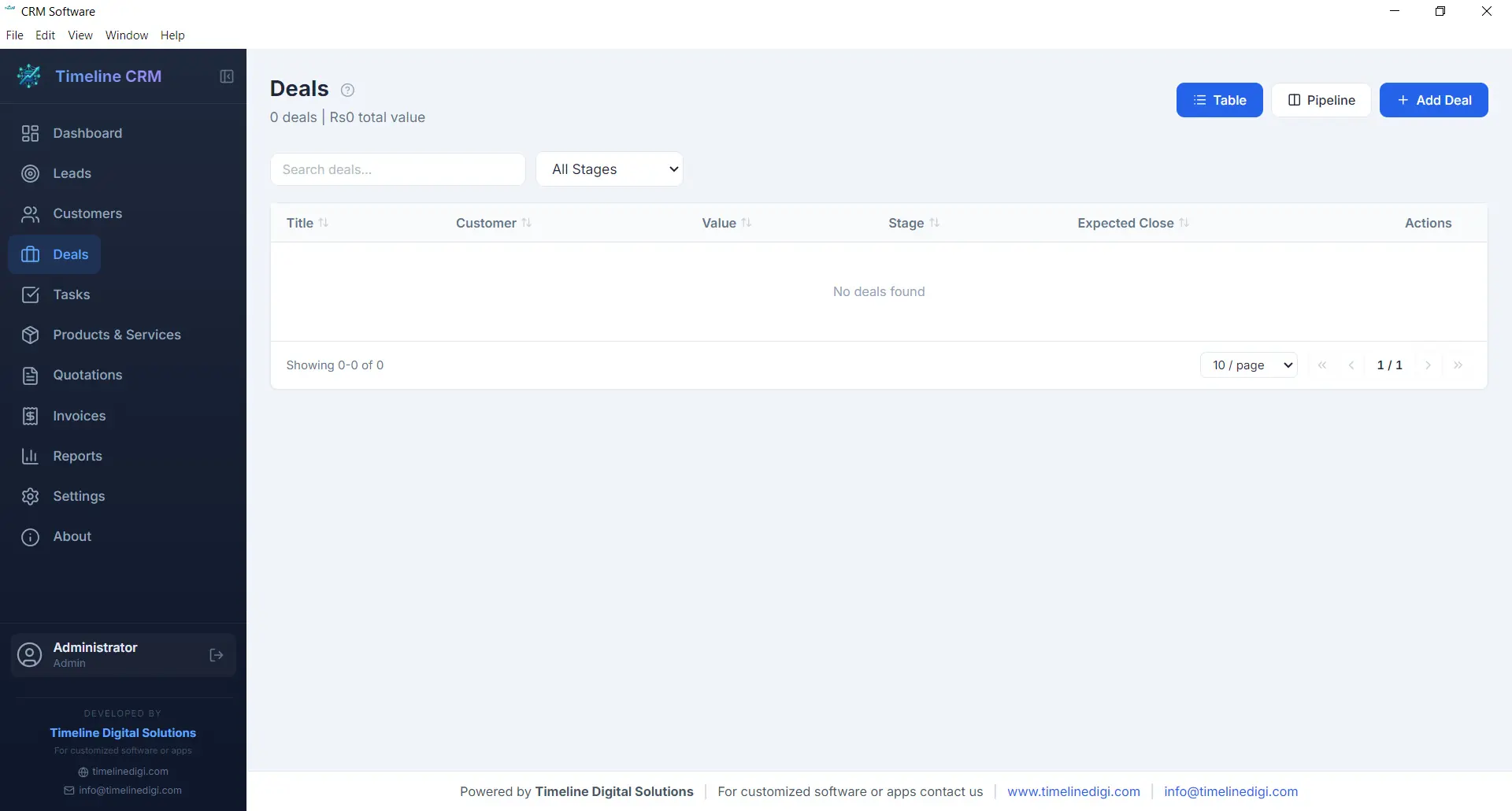
The Deals module tracks every sales opportunity from first conversation to closed contract. Each deal is assigned a monetary value, an expected close date, and a probability percentage, giving you accurate revenue forecasting at all times. The six-stage pipeline — Prospect, Qualification, Proposal, Negotiation, Won, and Lost — provides a clear visual workflow that keeps your sales process structured and predictable.
Deals are linked to specific customers and can reference related quotations, making it easy to track the progression from initial quote to final agreement. You can add notes, update stages with a single click, and monitor your weighted pipeline value to understand projected revenue. For business owners who need clarity on what money is coming in and when, the Deals module delivers that visibility.
- Six-stage pipeline: Prospect, Qualification, Proposal, Negotiation, Won, Lost
- Deal value, probability, and expected close date
- Revenue forecasting with weighted pipeline
- Linked to customers and quotations
Tasks
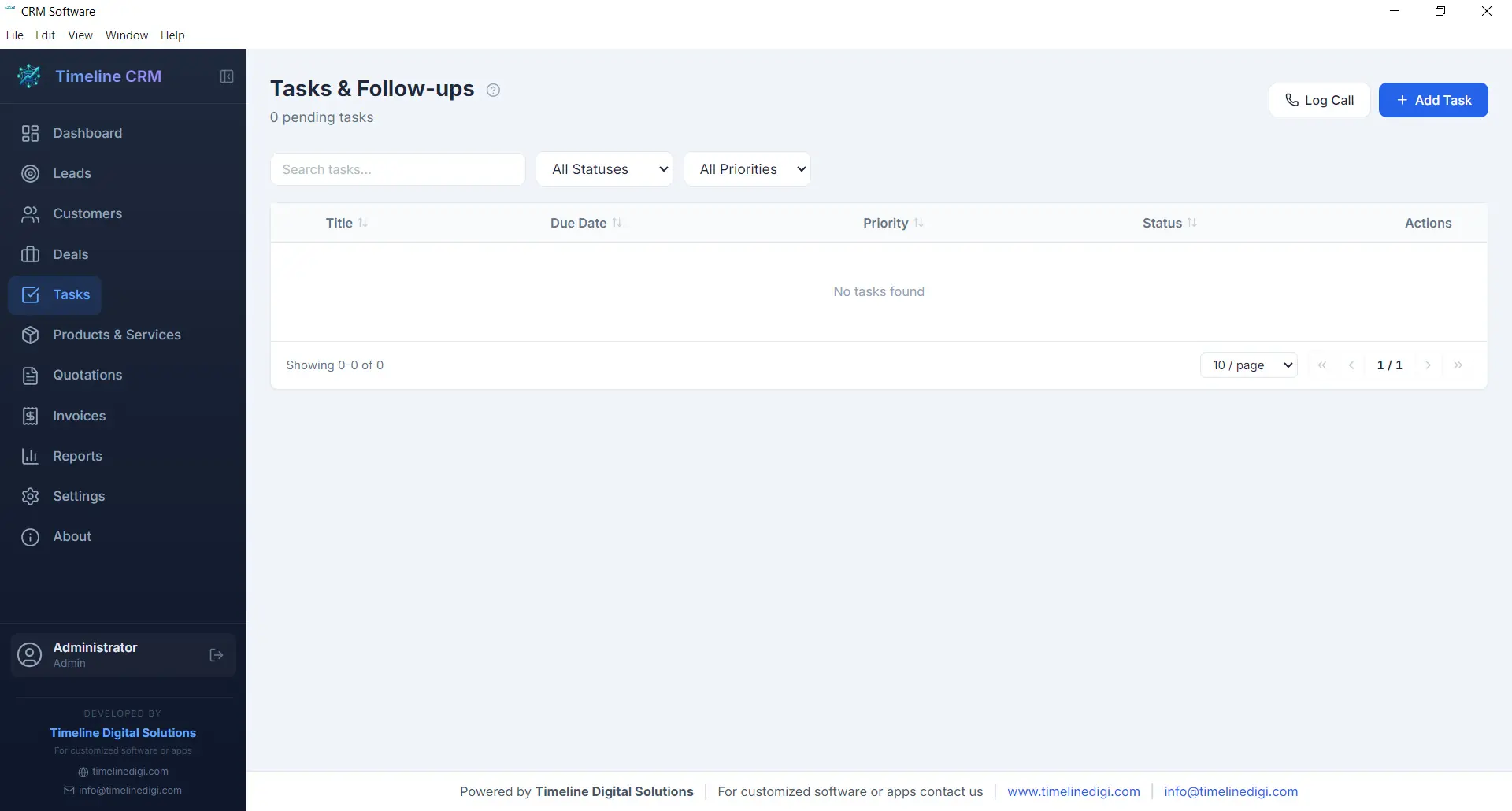
Staying organized is essential when you are managing multiple leads and deals simultaneously. The Tasks module gives you a straightforward way to create, prioritize, and track action items that keep your business moving forward. Each task can include a title, description, due date, priority level, and status, making it easy to see what needs attention right now.
Tasks can be linked to specific leads, customers, or deals, providing context about why the task exists and what it relates to. Whether you need to follow up with a prospect, prepare a proposal, or review an invoice, the Tasks module ensures nothing slips through the cracks. Overdue tasks are highlighted on the Dashboard so you can take action before opportunities are missed.
- Create tasks with due dates and priority levels
- Link tasks to leads, customers, or deals
- Status tracking: pending, in progress, completed
- Overdue task alerts on the Dashboard
Products
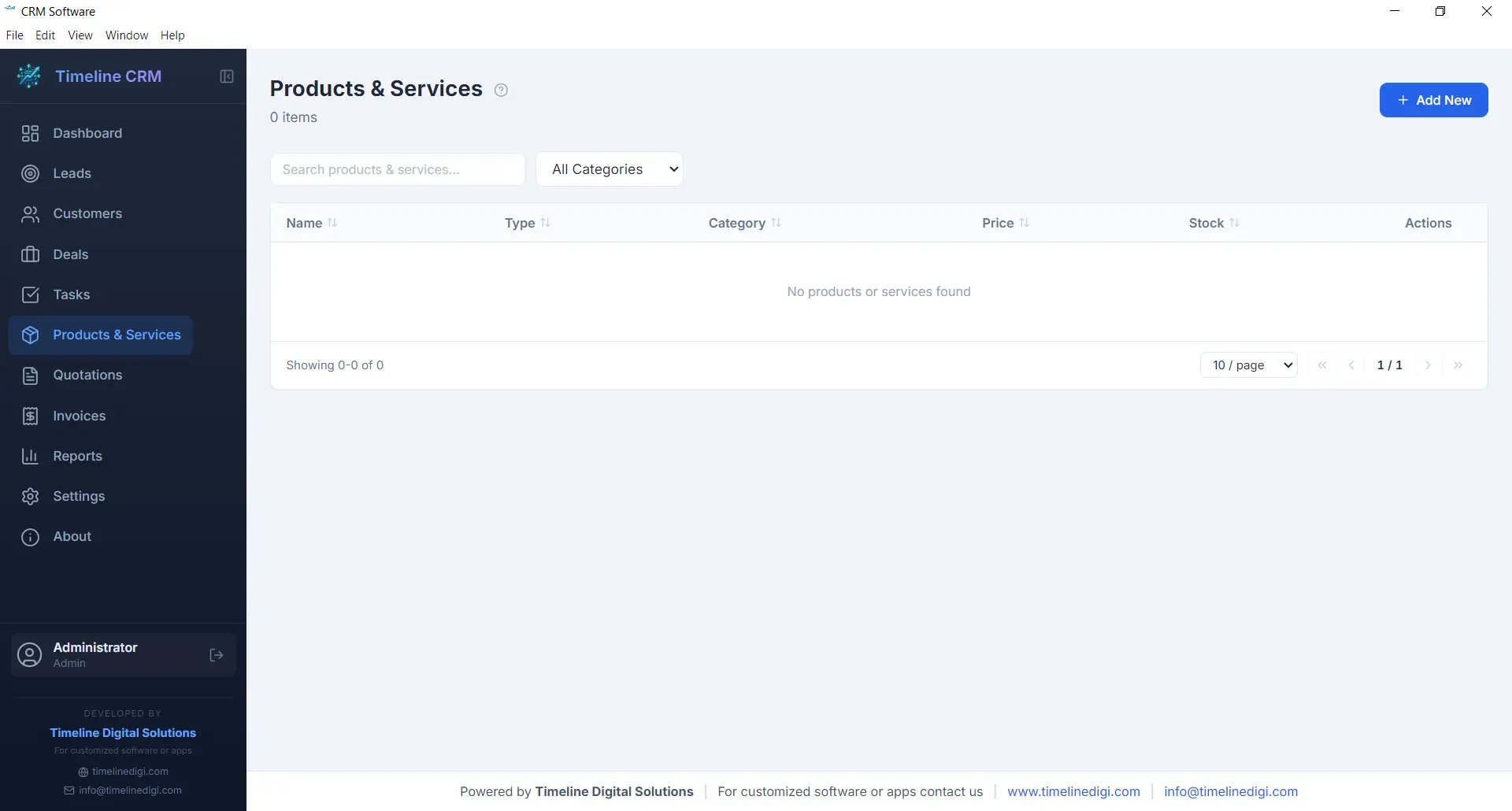
The Products module serves as your centralized catalog for everything your business sells, whether physical products, services, or subscription packages. Each product entry includes a name, description, unit price, and category, allowing you to build a well-organized inventory that feeds directly into your quotations and invoices.
Having a product catalog eliminates the repetitive task of manually entering item details every time you create a new quotation or invoice. Simply select products from your catalog, specify quantities, and the system handles the rest — including price calculations and line item formatting. This saves time, reduces errors, and ensures consistency across all your business documents.
- Centralized product and service catalog
- Name, description, price, and category fields
- Direct integration with quotations and invoices
- Unlimited product entries
Quotations
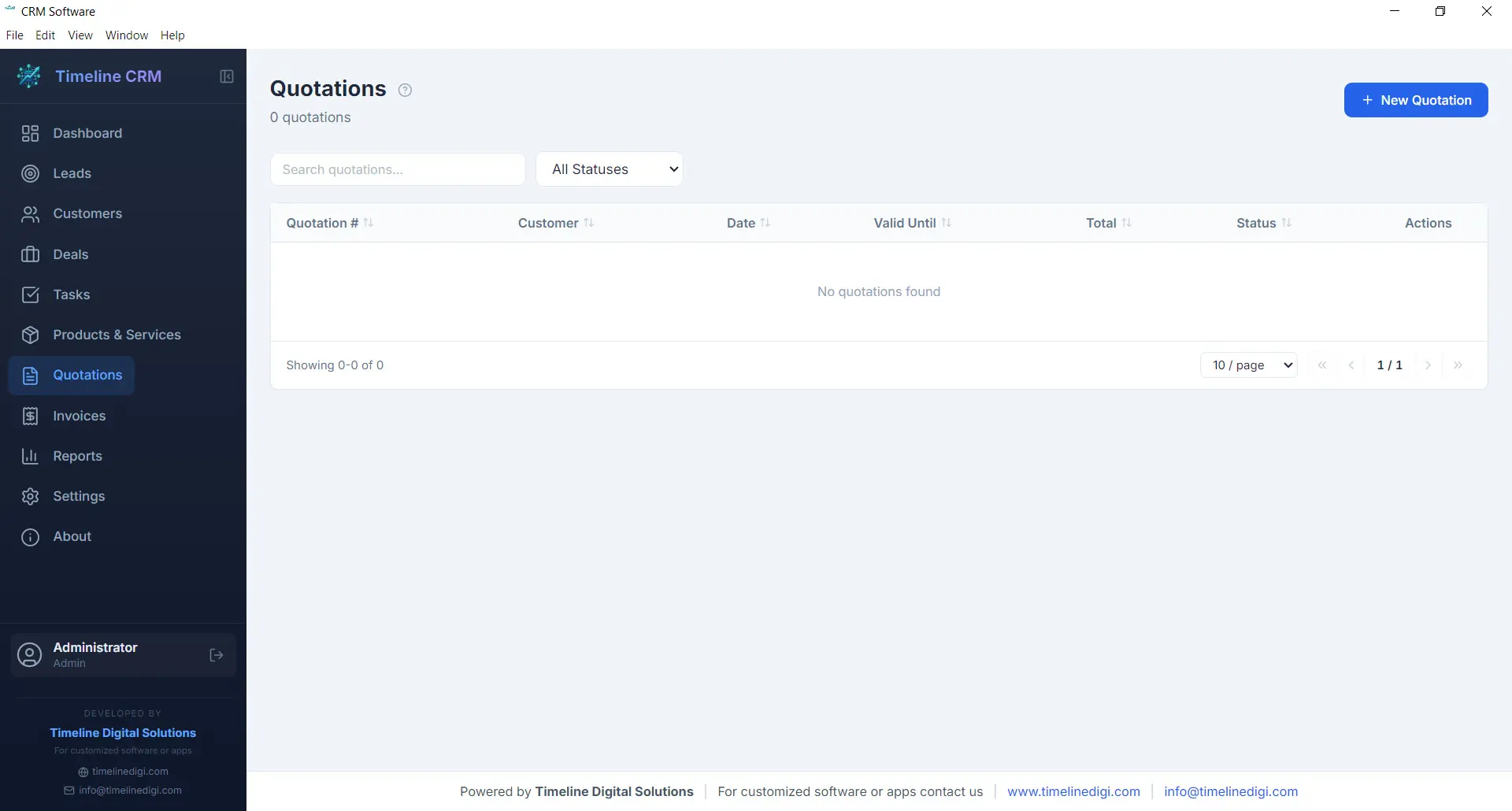
When a prospect is ready to hear your pricing, the Quotations module helps you respond quickly with a professional, branded document. Create quotations by selecting a customer, adding line items from your product catalog, adjusting quantities and pricing as needed, and generating a polished PDF in seconds. Auto-numbering ensures every quotation has a unique reference number for easy tracking.
Each quotation records the creation date, validity period, total amount, and current status. You can track whether a quote is pending, accepted, or rejected, giving you clear visibility into your conversion rates. Quotations can be linked to specific deals, so when a prospect accepts your quote, you can update the deal stage and move seamlessly toward closing the sale.
- Professional PDF quotation generation
- Auto-numbering with customizable prefix
- Line items from product catalog with quantity and pricing
- Status tracking: pending, accepted, rejected
Invoices
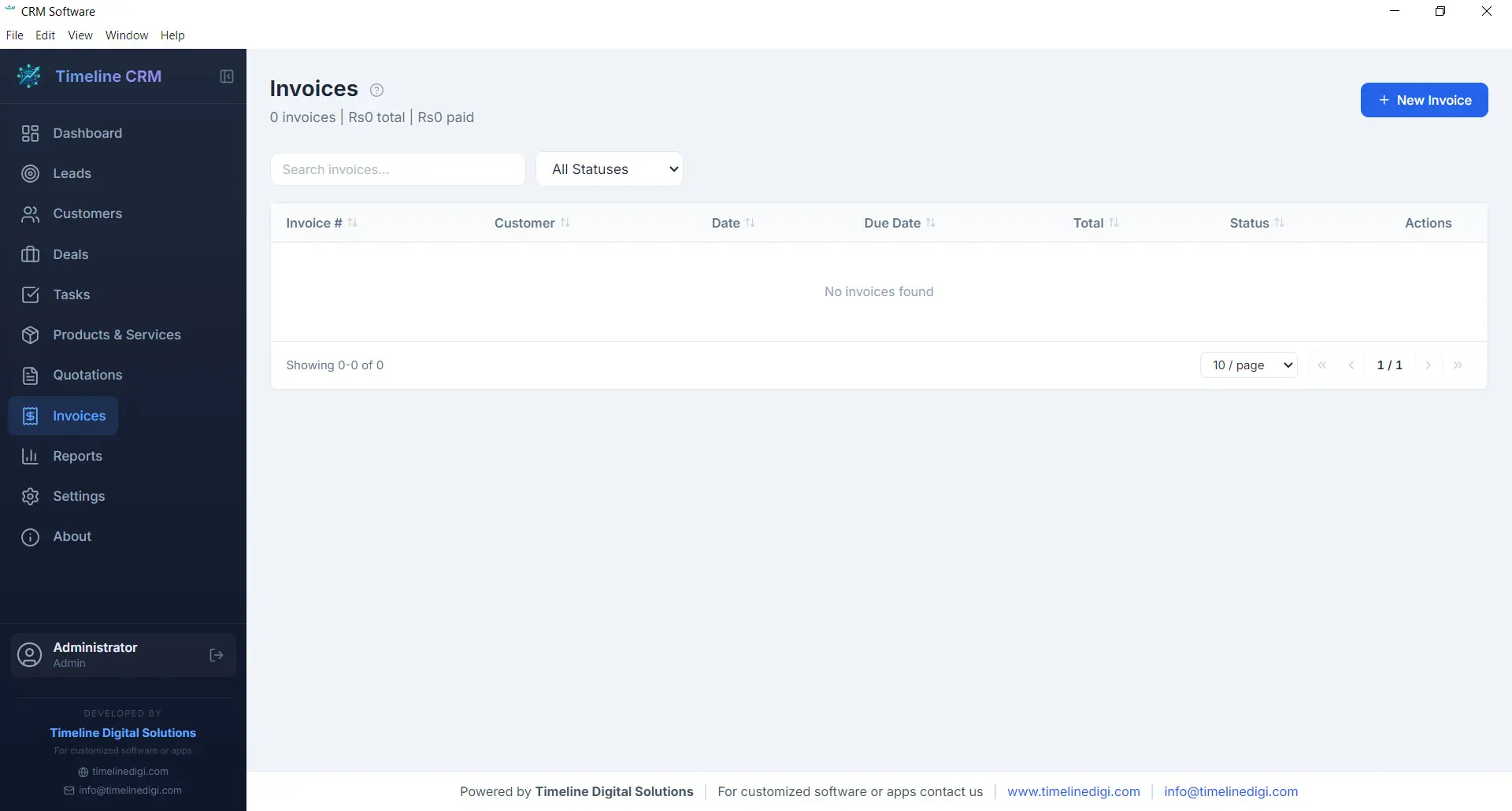
The Invoices module streamlines your billing workflow from creation to payment tracking. Generate detailed invoices with line items pulled from your product catalog, automatic tax calculations based on your configured rates, and professional formatting that represents your business well. Every invoice receives a unique auto-generated number for organized record keeping.
Track the payment status of each invoice — whether it is unpaid, partially paid, or fully settled — so you always know where your receivables stand. Export invoices as PDF documents to share with customers via email or print. The invoicing module works hand-in-hand with your customer and deal records, keeping your financial data connected to the rest of your business operations.
- PDF invoice generation with professional formatting
- Automatic tax calculations
- Payment status tracking: unpaid, partial, paid
- Auto-numbering with customizable prefix
Reports
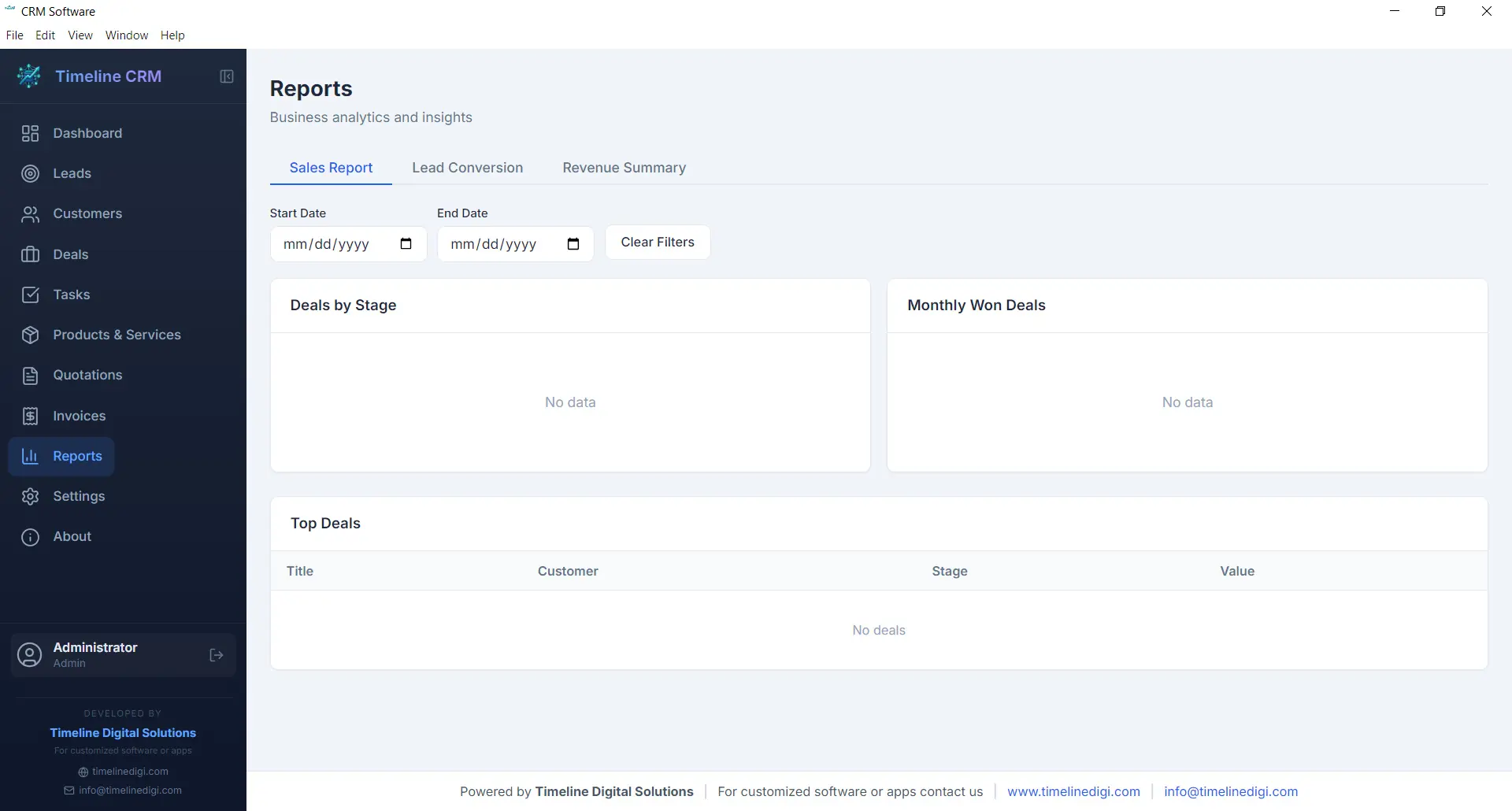
Data-driven decisions lead to better outcomes, and the Reports module gives you the insights you need without requiring a data analyst. Generate reports on sales performance, lead conversion rates, revenue trends, and pipeline health. Each report presents your data in clear, readable formats that help you understand what is working and what needs improvement.
Reports can be exported as CSV files for further analysis in spreadsheet applications or for sharing with business partners and accountants. Whether you need a monthly sales summary, a breakdown of deals by stage, or an overview of your lead sources, the Reports module produces the numbers you need to steer your business confidently.
- Sales performance and revenue reports
- Lead conversion and pipeline analysis
- CSV export for external analysis
- Visual charts and data summaries
Settings
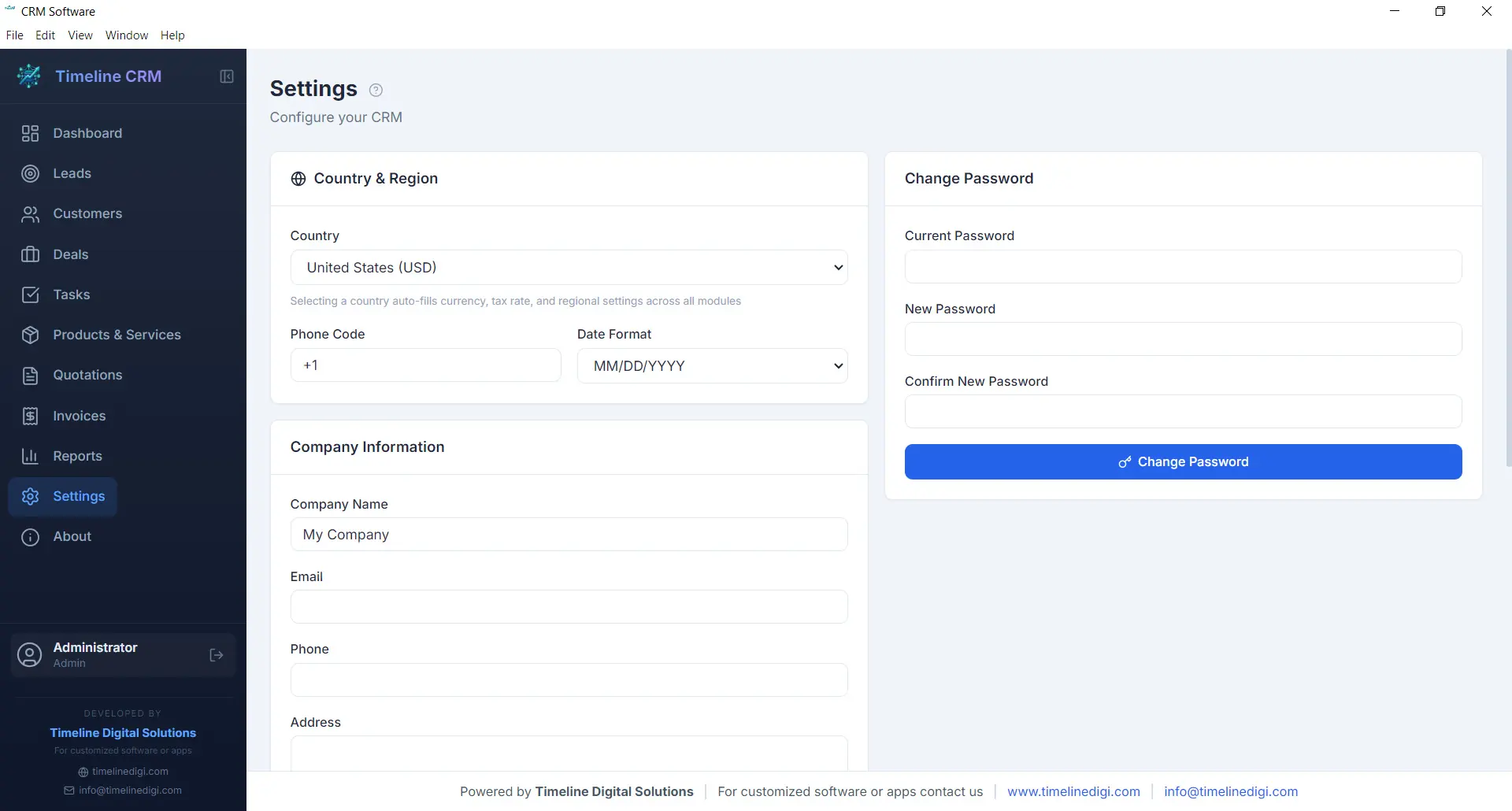
Every business has unique requirements, and the Settings module lets you tailor Timeline CRM to match yours. Configure your company name, logo, address, and contact details so that all generated documents — quotations and invoices — carry your branding. Set your preferred currency, tax rates, and country-based formatting to ensure financial calculations and number formats are correct for your region.
Customize auto-numbering prefixes for quotations and invoices to match your existing document numbering scheme. Adjust date formats, language preferences, and other display options to create a workspace that feels familiar and efficient. The Settings module is designed to be configured once and then work seamlessly in the background as you use every other module.
- Company profile and branding configuration
- Currency, tax, and country-based settings
- Auto-numbering prefix customization
- Date format and display preferences
Offline & Secure
Privacy and data ownership are fundamental principles of Timeline CRM. Unlike cloud-based CRM systems that store your sensitive business data on third-party servers, Timeline CRM keeps everything on your local machine. The application uses SQLite as its database engine, storing all your leads, customers, deals, invoices, and other records in a single file on your hard drive that you fully control.
Because the application works entirely offline, you are never vulnerable to server outages, internet disruptions, or subscription cancellations that could lock you out of your own data. Your business information is always accessible, always private, and always yours. Back up your data by simply copying the database file, and rest assured that no one else has access to your customer information.
- 100% local data storage using SQLite
- No internet connection required
- No third-party data access or sharing
- Simple file-based backup and portability
All These Features. Completely Free.
Every module, every feature, every capability described above is included at no cost. Download Timeline CRM and start using all eleven modules today — no trial period, no feature restrictions, no credit card required.
Download Timeline CRM FreeVersion 1.0.0 • Windows 10/11 • 64-bit
See Timeline CRM in Action
Timeline CRM helps businesses manage leads, contacts, deals, quotations, invoices, and follow-ups in one place. Explore core workflows and compare related guides to choose the best setup for your team.