
Best CRM for Small Business 2025: Free, Simple, and Built for Results
Small businesses face a unique challenge when it comes to customer relationship management. You know that organizing your contacts, tracking your sales pipeline, and following up consistently are critical to growth. But the CRM solutions dominating the market are designed for enterprises with dedicated IT teams and large software budgets. They come with complicated interfaces, steep learning curves, and monthly subscription fees that strain already tight budgets. As a small business owner, you need a CRM that respects your time and your wallet while still delivering the tools you need to manage customer relationships professionally. The best CRM for small business in 2025 is not the platform with the longest feature list or the biggest marketing budget. It is the one that fits naturally into your workflow, covers your essential needs without overwhelming complexity, and lets you focus on running your business instead of learning software.
Timeline CRM was built specifically for this purpose. It is a free desktop CRM application for Windows that delivers professional-grade lead management, deal tracking, invoicing, quotation generation, and reporting without any cost, any internet requirement, or any complicated setup. Developed by Timeline Digital Solutions using Electron, React, and SQLite, Timeline CRM gives small businesses the complete CRM toolkit they need in a package they can actually afford and actually use. This guide covers the challenges small businesses face with CRM adoption, what features matter most, and why Timeline CRM stands as the best choice in 2025.
Developed By
Timeline Digital Solutions
For customized software or apps, contact Timeline Digital Solutions. We build practical business software, CRM systems, and tailored digital tools for real-world business operations.
CRM Challenges Small Businesses Face
Small businesses operate in a fundamentally different environment than the enterprises that most CRM platforms are designed for. Budget constraints are real and immediate. Every dollar spent on software subscriptions is a dollar not spent on marketing, inventory, or hiring. When a cloud CRM charges fifty dollars per user per month, that is six hundred dollars a year for just one person. For a small team of three, the annual cost rises to nearly two thousand dollars before you factor in add-ons and premium features. These costs accumulate year after year, creating a permanent expense that grows as your team grows.
Time constraints are equally challenging. Small business owners wear multiple hats and cannot afford to spend days or weeks learning complex software. When a CRM requires extensive configuration, customization, and training before it becomes useful, most small businesses abandon the effort and return to spreadsheets or sticky notes. The implementation failure rate for CRM systems in small businesses is notoriously high, and complexity is the primary cause. The best CRM for small business must be instantly usable without specialized training.
Data concerns add another layer of difficulty. Small businesses are increasingly aware of privacy responsibilities, especially when handling customer contact information, financial data, and communication histories. Cloud CRM platforms require trusting a third-party vendor with this sensitive information, and data breaches at major SaaS companies make headlines regularly. Small businesses often lack the resources to evaluate vendor security practices thoroughly, creating an uncomfortable reliance on promises rather than control.
Finally, many small businesses operate in environments where internet connectivity is not always reliable. Field service businesses, rural operations, and professionals who travel frequently need access to their CRM data regardless of network availability. Cloud-dependent CRM solutions fail completely in these scenarios, turning a productivity tool into a frustration during the moments when it is needed most.
What to Look for in a Small Business CRM
When evaluating CRM options for your small business, focus on practical value rather than impressive-sounding features you will never use. The best CRM for small business excels at the fundamentals and stays out of your way while you work. Start with ease of use as your top criterion. If you cannot figure out how to add a contact, create a deal, or generate an invoice within your first ten minutes using the software, it is too complicated for small business use.
Feature coverage should match your actual workflow. Most small businesses need contact management for organizing customer and prospect information, a visual sales pipeline for tracking where each opportunity stands, task management for scheduling follow-ups and to-do items, quotation and invoice generation for professional billing, and reporting for understanding business performance. Any CRM that covers these five areas effectively serves the needs of the vast majority of small businesses. Features like marketing automation, AI-powered analytics, and multi-department workflows are enterprise capabilities that add complexity without adding value for most small operations.
Cost predictability is critical. The best CRM for small business should not create financial uncertainty with usage-based pricing, per-record charges, or annual price increases. You need to know exactly what the software will cost this month, next month, and three years from now. Free CRM software like Timeline CRM provides the ultimate cost predictability because the answer is always zero. There are no surprise charges, no escalating fees, and no budget adjustments required.
Data ownership and privacy should factor into your decision. Choose a CRM that gives you control over your customer data rather than requiring you to entrust it to a vendor whose business model depends on your continued subscription. Desktop CRM software stores your data on your own hardware, ensuring you always have full ownership and access regardless of vendor decisions, pricing changes, or service disruptions.
Why Free and Offline CRM Matters for Small Business
The financial impact of CRM software costs on a small business is proportionally much larger than on an enterprise. When a company with five hundred employees pays for CRM software, it is a line item in a massive technology budget. When a sole proprietor or small team pays for the same software, it may represent a significant percentage of total software spending. Free CRM software eliminates this burden entirely, allowing small businesses to invest that money where it generates direct returns.
Beyond the direct financial savings, free CRM software removes the psychological barrier to adoption. When software costs money, business owners hesitate to commit, often spending weeks evaluating options and negotiating contracts instead of actually using a CRM. When the software is free, there is zero risk in trying it immediately. If it works for your workflow, you keep using it. If not, you have lost nothing but a few minutes of installation time. This friction-free adoption path is one of the most significant advantages of free CRM software for small businesses.
Offline capability addresses real-world working conditions that cloud CRM vendors prefer to ignore. Small business owners often work from locations without reliable internet, including client sites, trade shows, rural areas, and during travel. A CRM that stops working when the internet drops is fundamentally unreliable for mobile professionals. Timeline CRM runs entirely on your local machine, so it is available in every situation where your laptop is available. You can update lead records during a client meeting, create quotations at a trade show booth, or review reports during a flight without any connectivity.
The combination of free pricing and offline access creates a CRM experience that is uniquely suited to how small businesses actually operate. There are no monthly bills to manage, no internet dependencies to worry about, and no vendor relationships to maintain. It is just you and your data, organized and accessible whenever and wherever you need it. This simplicity is what makes Timeline CRM the best CRM for small business in 2025.
How Timeline CRM Solves Small Business Needs
Timeline CRM was designed with small business workflows as the primary use case, not as an afterthought or a stripped-down version of enterprise software. Every module, every interface decision, and every feature was built to serve the needs of solo operators, freelancers, and small teams who need professional CRM capabilities without enterprise complexity. The result is a CRM that feels natural from the first interaction and delivers tangible productivity improvements from day one.
The lead management module provides a visual 7-stage pipeline with Kanban board functionality that lets you see your entire prospect funnel at a glance. Drag leads between stages, log calls and notes against each contact, and set follow-up tasks that ensure no opportunity falls through the cracks. When a lead qualifies, convert them to a customer record that carries forward all their history and context. The deal pipeline adds a separate 6-stage tracking system for active sales opportunities, with value tracking that feeds directly into revenue forecasting reports.
For billing and documentation, Timeline CRM includes quotation generation with auto-numbering and PDF export that lets you send professional proposals within minutes. Accepted quotations convert to invoices seamlessly, with payment status tracking that keeps your accounts receivable clear and current. The product catalog module maintains your service and product listings so you can build quotations and invoices quickly from standardized line items rather than typing everything from scratch.
The reporting and analytics module rounds out the experience by transforming your raw data into actionable insights. View lead conversion rates, deal pipeline velocity, revenue trends, and activity metrics through clear visual charts. These reports help you identify which lead sources produce the best results, which pipeline stages have bottlenecks, and how your sales performance trends over time. For a small business, this level of insight was previously available only through expensive paid platforms.
Key Timeline CRM Modules for Small Business
Every module listed below is included free in Timeline CRM with no restrictions, no record limits, and no locked features. Together they form a complete small business management toolkit.
Leads Pipeline
Capture and track every prospect through a visual 7-stage pipeline. Use Kanban drag-and-drop to move leads between stages, log activities, and set follow-ups. Never lose track of a potential customer again with a structured approach to lead management.
Customer Management
Maintain detailed profiles for every customer with contact information, communication history, and relationship notes. Convert qualified leads to customers with a single click and keep all context from the lead stage intact for seamless relationship continuity.
Deals Tracking
Manage active sales opportunities through a 6-stage deal pipeline with monetary value tracking. Monitor expected close dates and deal progress to forecast revenue accurately and focus your efforts on the opportunities most likely to close.
Task Management
Schedule follow-ups, set reminders, and track to-do items linked to leads, customers, and deals. The task system ensures consistent follow-up discipline, which is the single most impactful habit for small business sales success.
Quotations and Invoices
Create professional quotations with auto-numbering and PDF export. Convert accepted quotes to invoices with payment tracking. Maintain a clean financial workflow from proposal through payment without needing separate billing software.
Reports and Analytics
Understand your business performance with visual charts covering lead conversion, pipeline health, revenue trends, and activity metrics. Make data-driven decisions instead of relying on gut feelings about what is working in your sales process.
Frequently Asked Questions About CRM for Small Business
What is the best CRM for small business in 2025? ▾
Timeline CRM is the best CRM for small business in 2025 because it combines comprehensive features with zero cost and complete simplicity. It includes lead management, deal pipelines, invoicing, quotations, task tracking, and reporting across 11 integrated modules. Unlike cloud CRMs that charge per user per month, Timeline CRM is 100% free and works offline on your Windows computer.
Do small businesses really need a CRM system? ▾
Yes, small businesses benefit enormously from CRM systems. Without a CRM, customer data gets scattered across spreadsheets, emails, and notebooks, leading to missed follow-ups and lost deals. A CRM centralizes all your customer information, automates pipeline tracking, and ensures no opportunity slips through the cracks. Even a one-person business sees significant improvements in organization and follow-up consistency.
How much should a small business spend on CRM? ▾
Many small businesses overspend on CRM software by subscribing to cloud platforms with features they never use. Costs range from $15 to $150 per user per month for popular options. However, you do not need to spend anything. Timeline CRM provides enterprise-level CRM features completely free, making it the most cost-effective option for small businesses with limited budgets.
What CRM features matter most for small businesses? ▾
Small businesses should prioritize contact management, lead and deal pipeline tracking, task and follow-up scheduling, invoicing and quotation generation, and basic reporting. Marketing automation and team collaboration are nice to have but not essential for most small operations. Timeline CRM covers every essential feature plus invoicing, quotations with PDF export, and comprehensive analytics.
Can I use Timeline CRM without technical knowledge? ▾
Absolutely. Timeline CRM is designed for business owners, not IT specialists. The interface uses familiar patterns like forms, lists, and drag-and-drop Kanban boards that anyone comfortable with basic computer use can master in minutes. There is no configuration required, no database setup, and no technical knowledge needed to start managing leads, creating invoices, and tracking deals.
Is a cloud CRM or desktop CRM better for small business? ▾
For small businesses, desktop CRM offers significant advantages including lower cost (often free), better data privacy, faster performance, and offline access. Cloud CRMs are better for teams that need real-time collaboration across locations. If you are a solo operator or small team working from one location, a desktop CRM like Timeline CRM provides better value and simplicity.
How long does it take to set up a CRM for small business? ▾
Timeline CRM can be set up in under five minutes. Download the installer, run it on your Windows 10 or 11 computer, and start adding contacts immediately. There is no account creation, no email verification, and no initial configuration required. Most users are productively managing leads and creating quotations within their first thirty minutes of use.
Can Timeline CRM grow with my small business? ▾
Yes. Timeline CRM has no limits on leads, customers, deals, invoices, or any other records. The SQLite database technology it uses can handle hundreds of thousands of records without performance degradation. As your business grows and your contact list expands, Timeline CRM scales with you without introducing additional costs or requiring a platform migration.
Start Using the Best Small Business CRM Today
Your small business deserves professional CRM tools without professional-tier pricing. Timeline CRM gives you everything you need to manage leads, close deals, and create invoices, all for free. Download now and see the difference organized customer management makes.
Download Timeline CRM FreeRelated Resources
CRM for Small Business
Complete guide to CRM solutions built for small business needs.
Free CRM Software
Learn about the best free CRM software available for download.
Best CRM 2025
Compare the top CRM solutions and find the best fit for you.
Features
Explore all 11 modules included in Timeline CRM for free.
Every Feature You Need,
Zero Cost
Timeline CRM packs a complete suite of business management tools into one free desktop application. From lead capture to invoice generation, every module is designed to help small businesses operate more efficiently without paying for expensive cloud subscriptions.
Dashboard
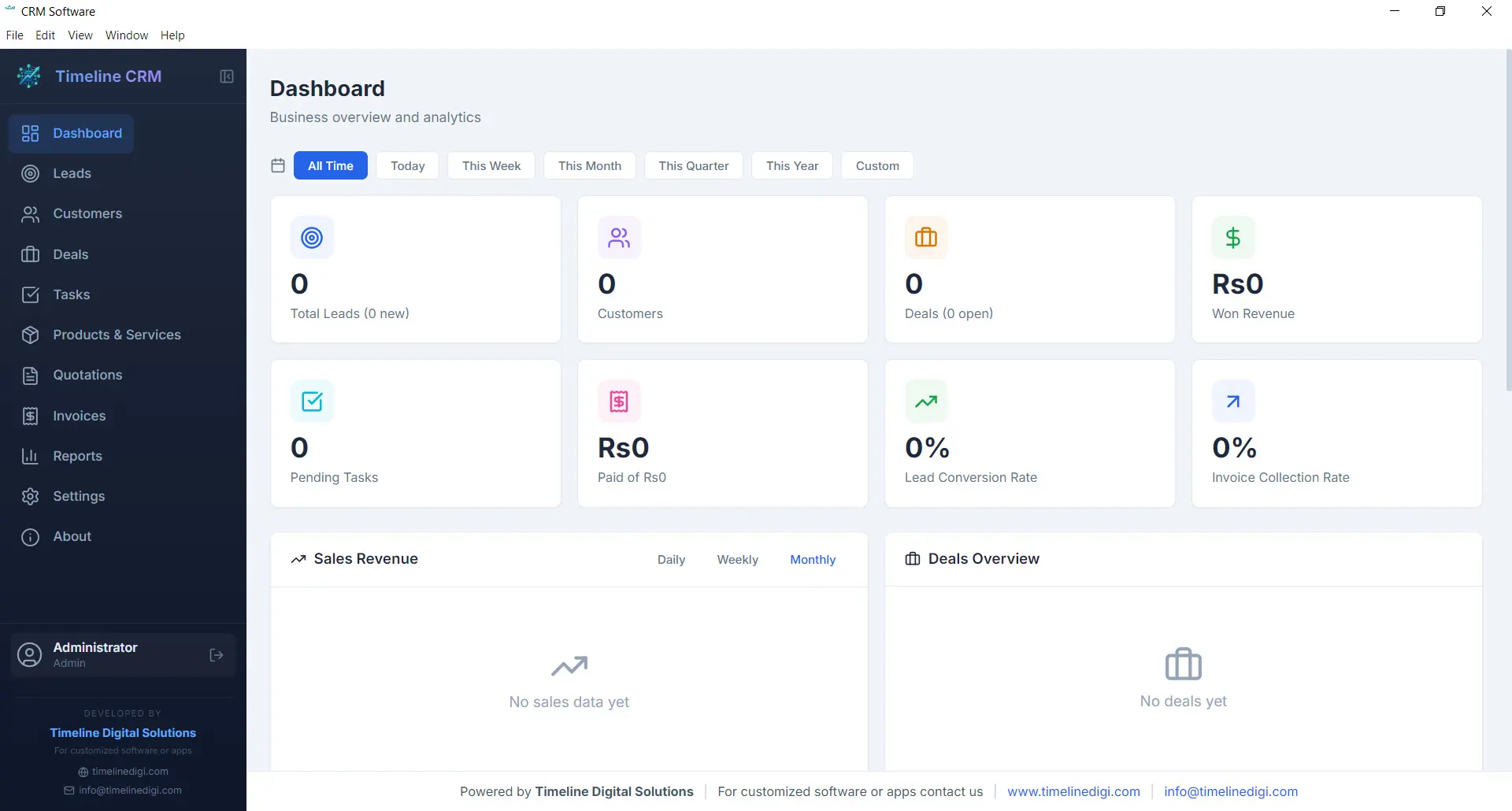
The Dashboard is your command center. Every time you open Timeline CRM, you are greeted with a comprehensive overview of your business performance. Key metrics are displayed prominently so you can gauge the health of your sales pipeline, track revenue trends, and identify areas that need attention — all without clicking through multiple screens.
Visual charts and summary cards present your data in an easy-to-digest format. Whether you want to see how many new leads came in this week, what your total deal value looks like, or which tasks are overdue, the Dashboard surfaces that information instantly. It is the first thing you see and the fastest way to stay on top of your business.
- Real-time business metrics and KPI cards
- Sales pipeline distribution chart
- Recent activity feed and upcoming tasks
- Revenue and lead trend visualizations
Leads
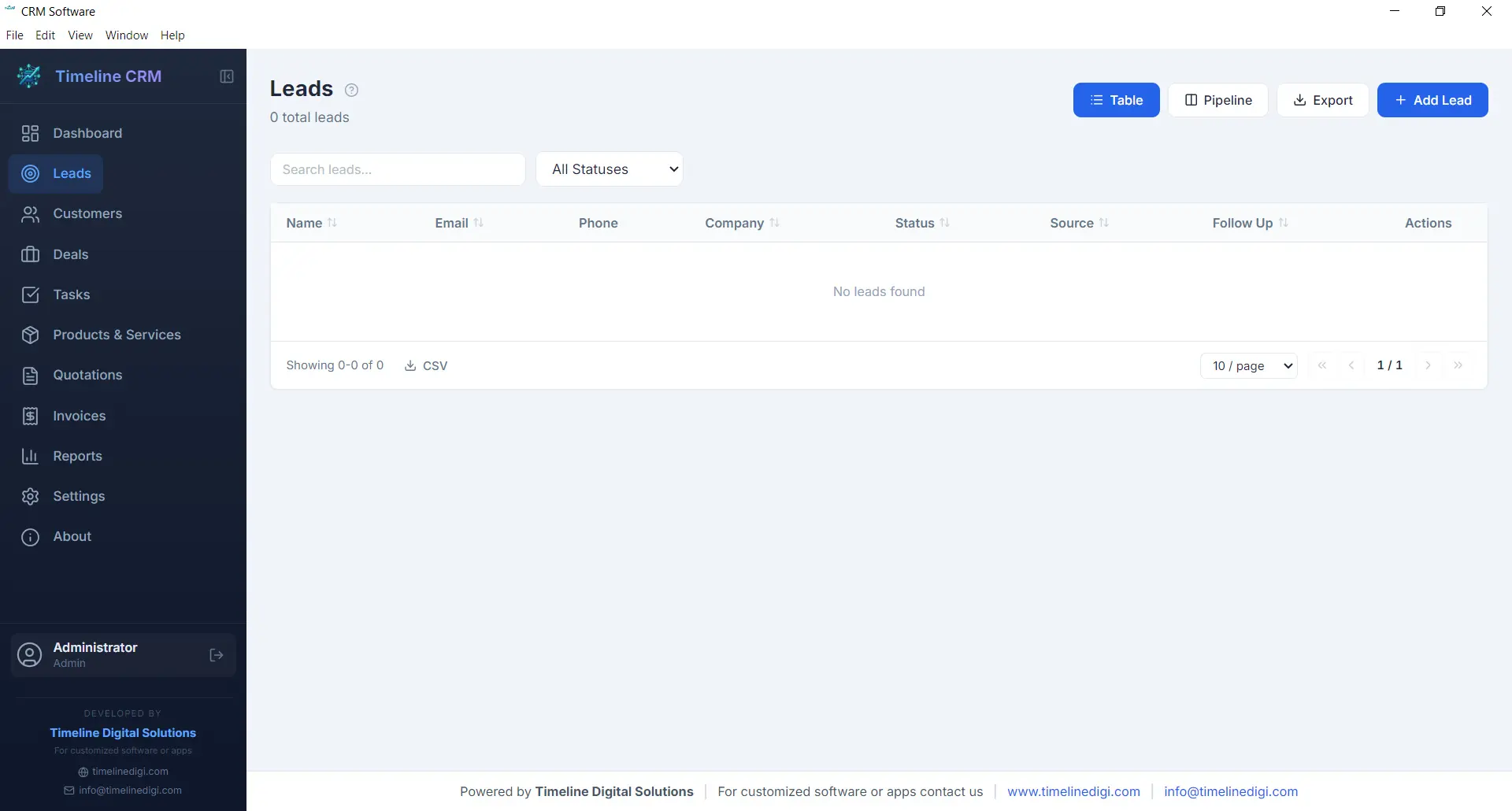
The Leads module is where every potential customer relationship begins. Capture new leads with detailed contact information, company details, and source tracking. Each lead is placed into a structured seven-stage pipeline — New, Contacted, Qualified, Proposal, Negotiation, Won, and Lost — so you always know exactly where every prospect stands in your sales process.
As you work with each lead, you can log phone calls, record meeting notes, attach documents, and track every interaction. This complete history ensures that no context is lost when you follow up days or weeks later. The pipeline view gives you a visual representation of your entire lead funnel, making it easy to spot bottlenecks and prioritize your outreach efforts.
- Seven-stage pipeline: New, Contacted, Qualified, Proposal, Negotiation, Won, Lost
- Call logging with date, duration, and notes
- Lead source and priority tracking
- Convert leads to customers with one click
Customers
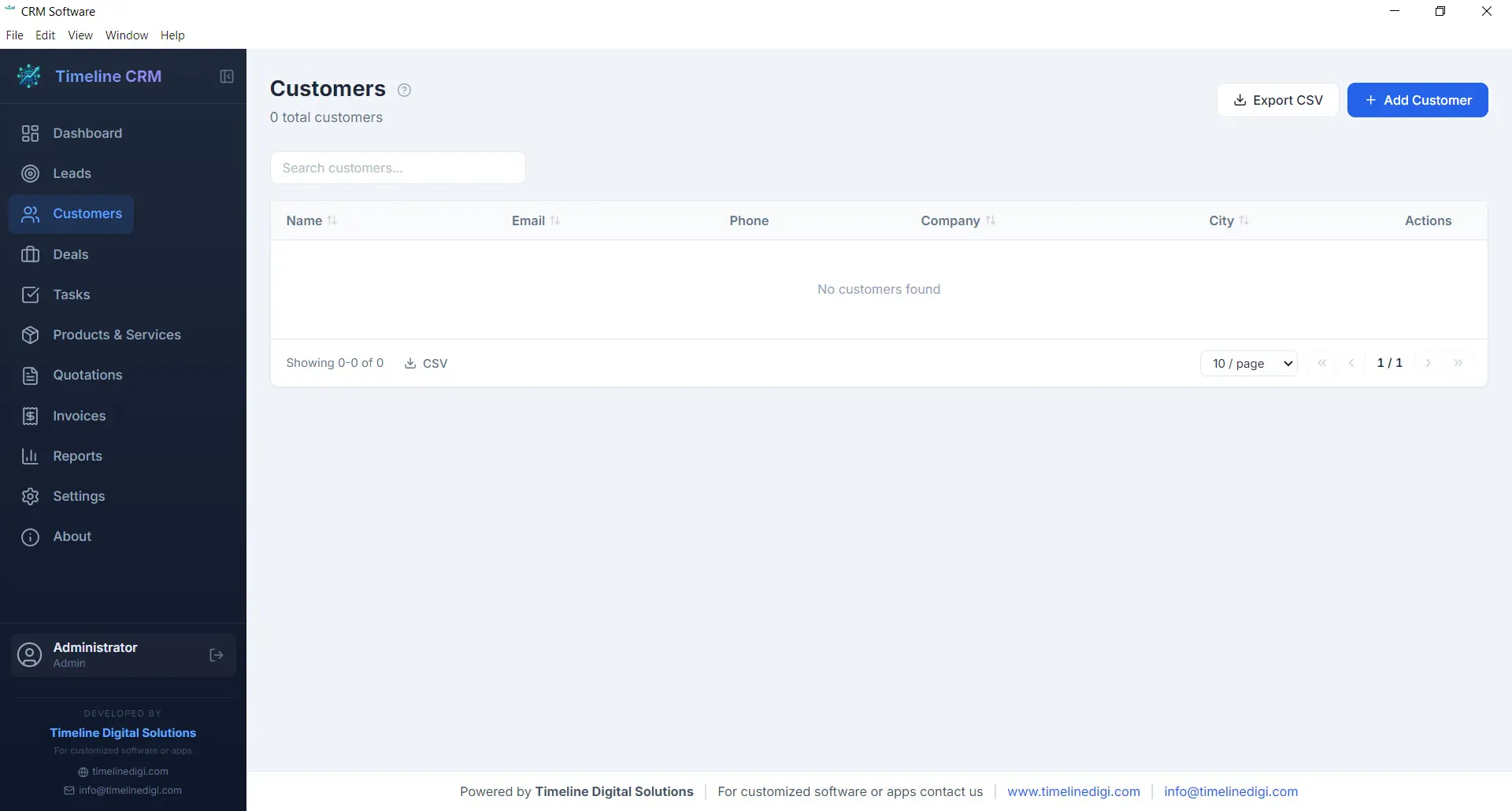
Your customers are the backbone of your business, and the Customers module helps you manage every relationship with care. Store comprehensive contact information, company details, billing addresses, and communication preferences in one organized record. When a lead is converted to a customer, all their history transfers automatically so nothing is lost in the transition.
Each customer profile acts as a hub connecting all related business data. Open any customer record and you can instantly view their associated deals, outstanding invoices, past quotations, and every note or interaction logged over time. This 360-degree view enables you to provide better service, anticipate needs, and build long-term relationships that drive repeat business.
- Complete contact and company profiles
- Full interaction and transaction history
- Linked deals, invoices, and quotations
- CSV export for customer data
Deals
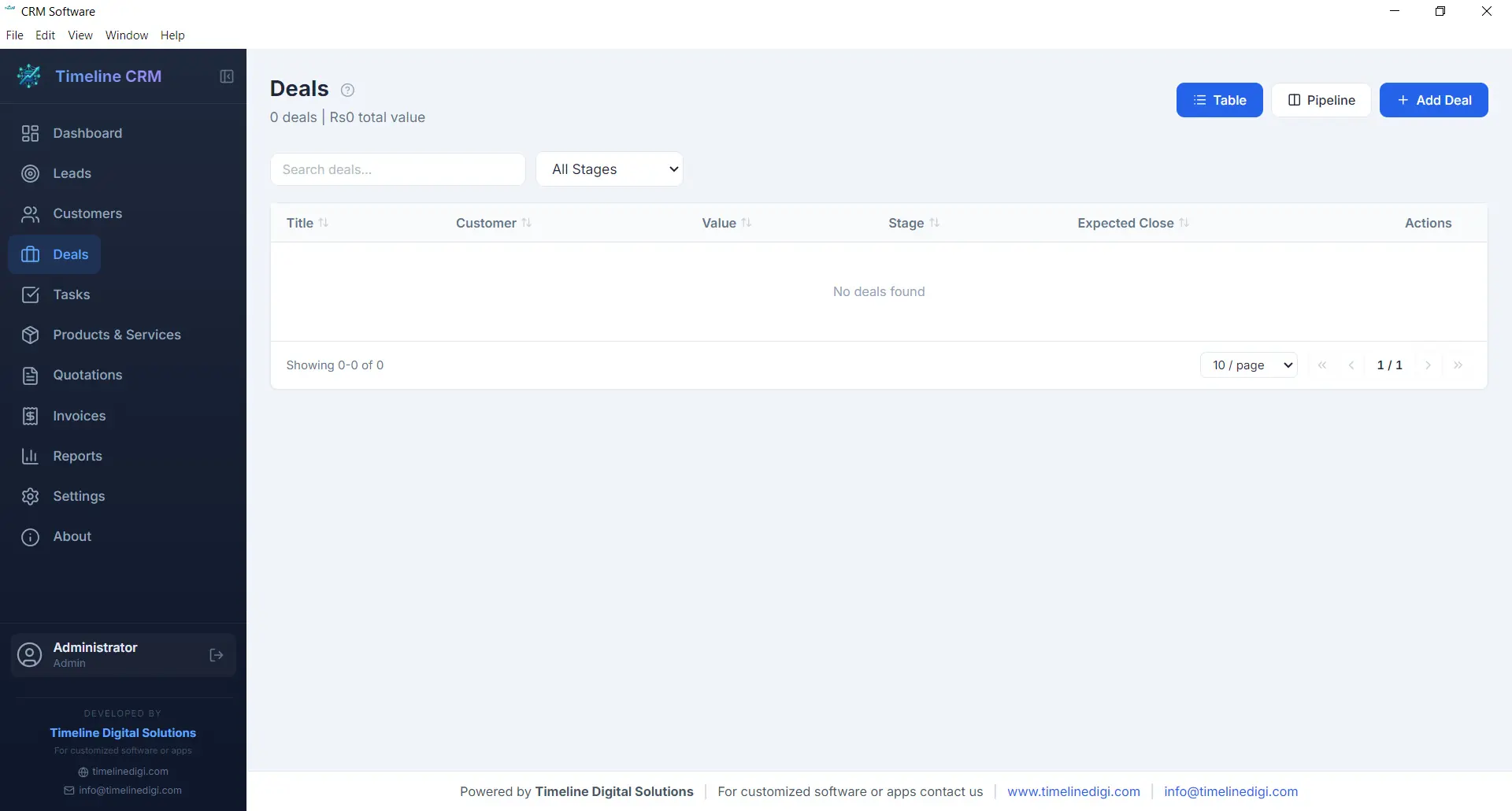
The Deals module tracks every sales opportunity from first conversation to closed contract. Each deal is assigned a monetary value, an expected close date, and a probability percentage, giving you accurate revenue forecasting at all times. The six-stage pipeline — Prospect, Qualification, Proposal, Negotiation, Won, and Lost — provides a clear visual workflow that keeps your sales process structured and predictable.
Deals are linked to specific customers and can reference related quotations, making it easy to track the progression from initial quote to final agreement. You can add notes, update stages with a single click, and monitor your weighted pipeline value to understand projected revenue. For business owners who need clarity on what money is coming in and when, the Deals module delivers that visibility.
- Six-stage pipeline: Prospect, Qualification, Proposal, Negotiation, Won, Lost
- Deal value, probability, and expected close date
- Revenue forecasting with weighted pipeline
- Linked to customers and quotations
Tasks
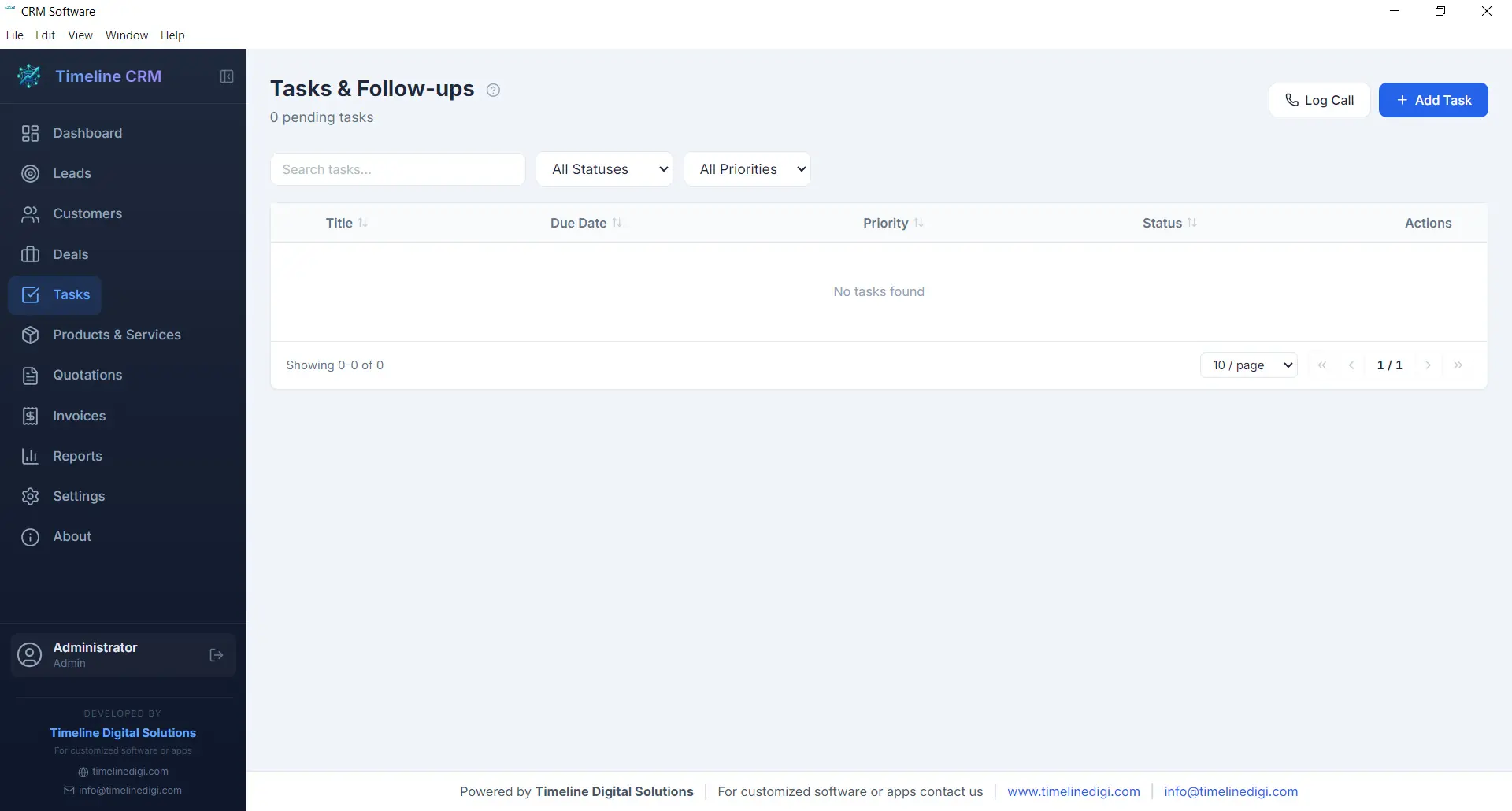
Staying organized is essential when you are managing multiple leads and deals simultaneously. The Tasks module gives you a straightforward way to create, prioritize, and track action items that keep your business moving forward. Each task can include a title, description, due date, priority level, and status, making it easy to see what needs attention right now.
Tasks can be linked to specific leads, customers, or deals, providing context about why the task exists and what it relates to. Whether you need to follow up with a prospect, prepare a proposal, or review an invoice, the Tasks module ensures nothing slips through the cracks. Overdue tasks are highlighted on the Dashboard so you can take action before opportunities are missed.
- Create tasks with due dates and priority levels
- Link tasks to leads, customers, or deals
- Status tracking: pending, in progress, completed
- Overdue task alerts on the Dashboard
Products
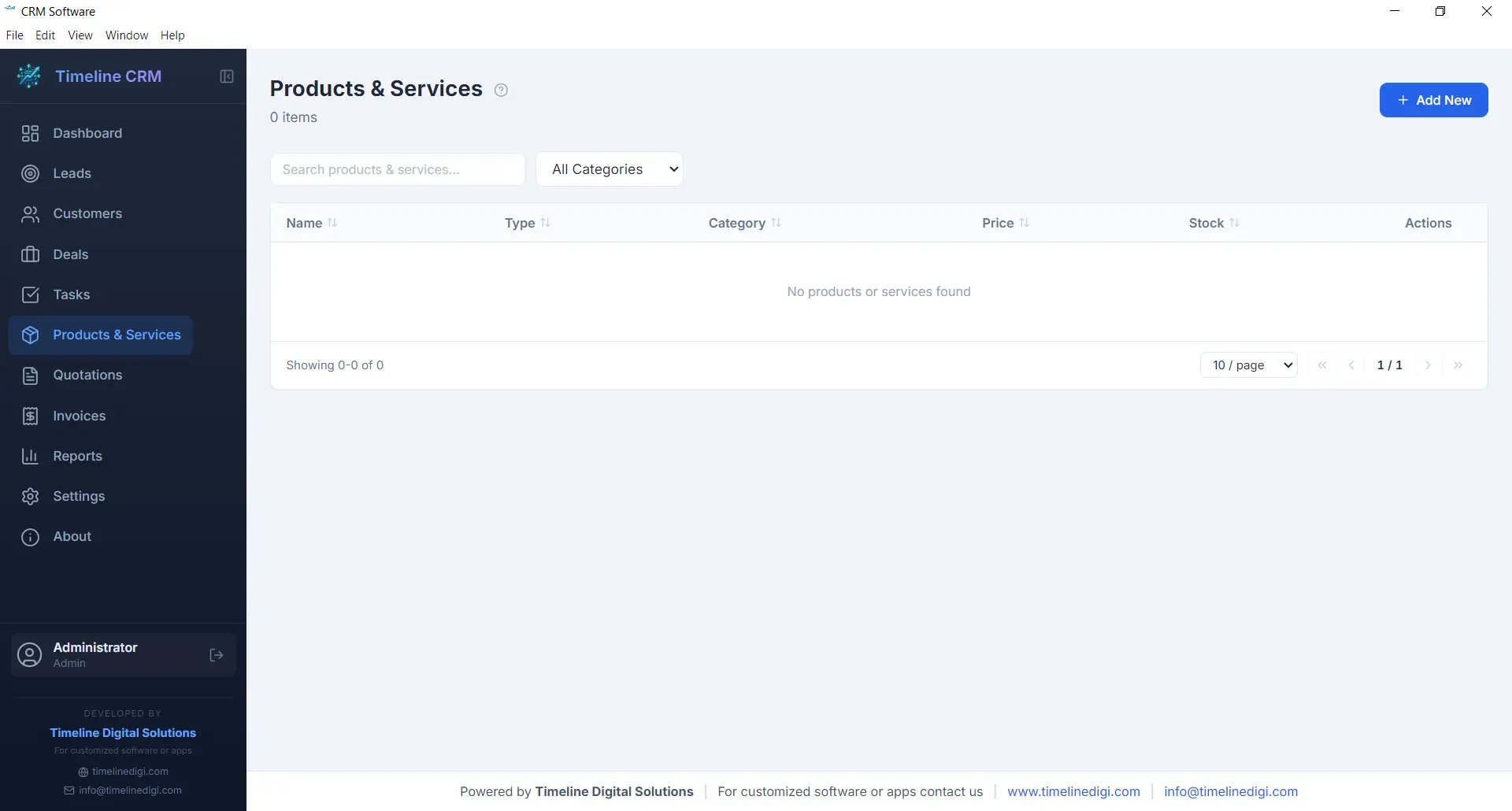
The Products module serves as your centralized catalog for everything your business sells, whether physical products, services, or subscription packages. Each product entry includes a name, description, unit price, and category, allowing you to build a well-organized inventory that feeds directly into your quotations and invoices.
Having a product catalog eliminates the repetitive task of manually entering item details every time you create a new quotation or invoice. Simply select products from your catalog, specify quantities, and the system handles the rest — including price calculations and line item formatting. This saves time, reduces errors, and ensures consistency across all your business documents.
- Centralized product and service catalog
- Name, description, price, and category fields
- Direct integration with quotations and invoices
- Unlimited product entries
Quotations
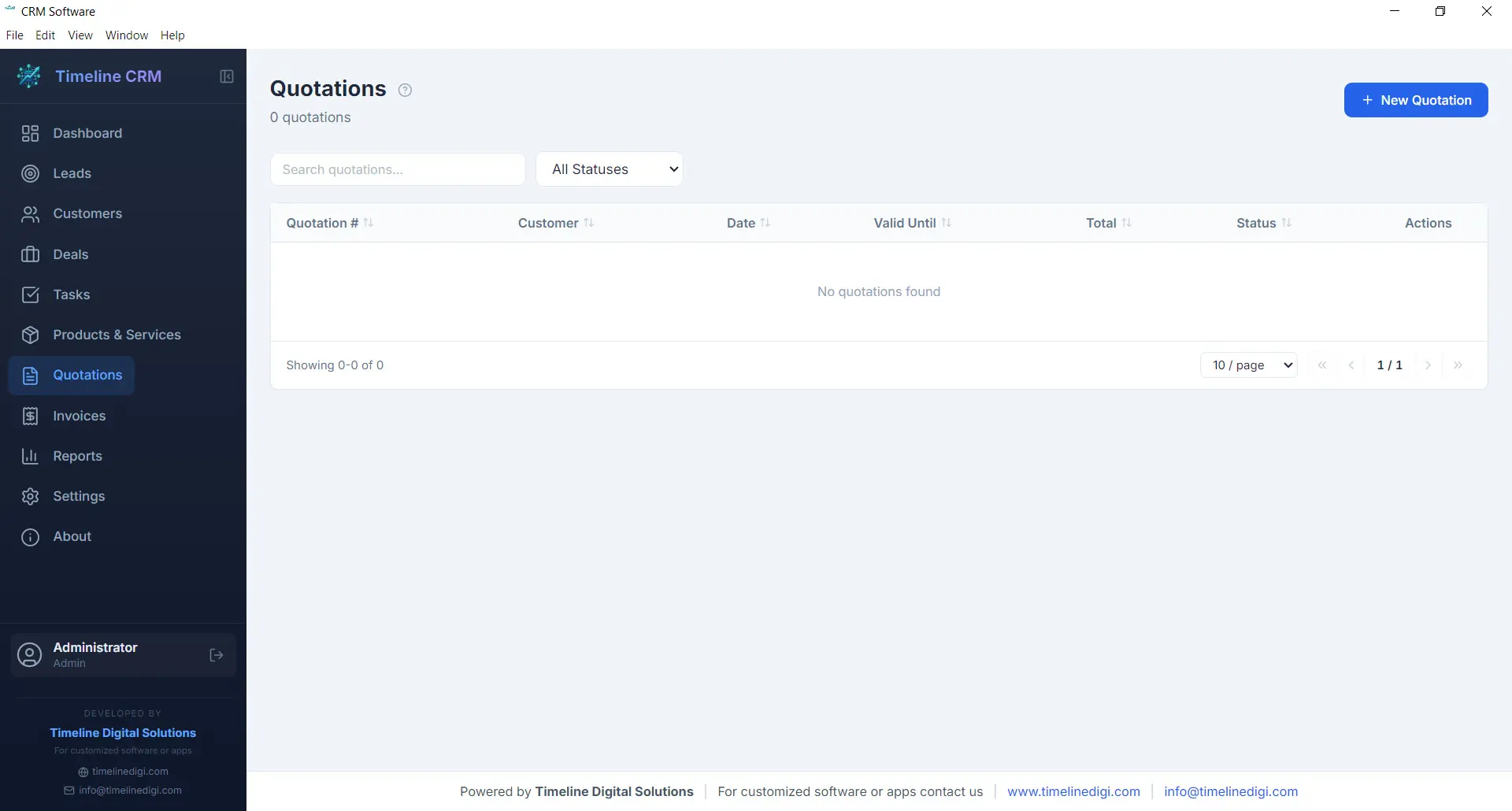
When a prospect is ready to hear your pricing, the Quotations module helps you respond quickly with a professional, branded document. Create quotations by selecting a customer, adding line items from your product catalog, adjusting quantities and pricing as needed, and generating a polished PDF in seconds. Auto-numbering ensures every quotation has a unique reference number for easy tracking.
Each quotation records the creation date, validity period, total amount, and current status. You can track whether a quote is pending, accepted, or rejected, giving you clear visibility into your conversion rates. Quotations can be linked to specific deals, so when a prospect accepts your quote, you can update the deal stage and move seamlessly toward closing the sale.
- Professional PDF quotation generation
- Auto-numbering with customizable prefix
- Line items from product catalog with quantity and pricing
- Status tracking: pending, accepted, rejected
Invoices
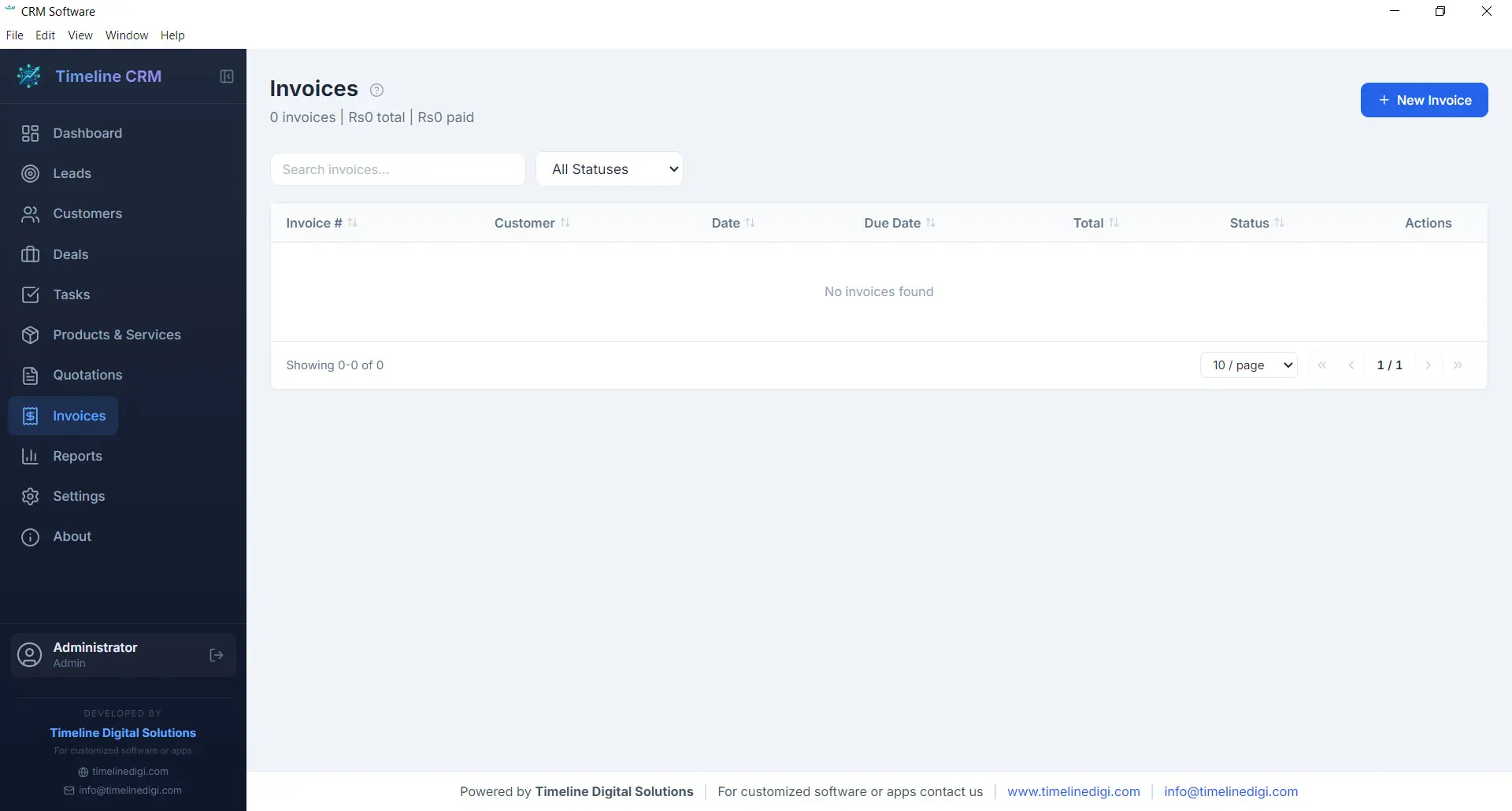
The Invoices module streamlines your billing workflow from creation to payment tracking. Generate detailed invoices with line items pulled from your product catalog, automatic tax calculations based on your configured rates, and professional formatting that represents your business well. Every invoice receives a unique auto-generated number for organized record keeping.
Track the payment status of each invoice — whether it is unpaid, partially paid, or fully settled — so you always know where your receivables stand. Export invoices as PDF documents to share with customers via email or print. The invoicing module works hand-in-hand with your customer and deal records, keeping your financial data connected to the rest of your business operations.
- PDF invoice generation with professional formatting
- Automatic tax calculations
- Payment status tracking: unpaid, partial, paid
- Auto-numbering with customizable prefix
Reports
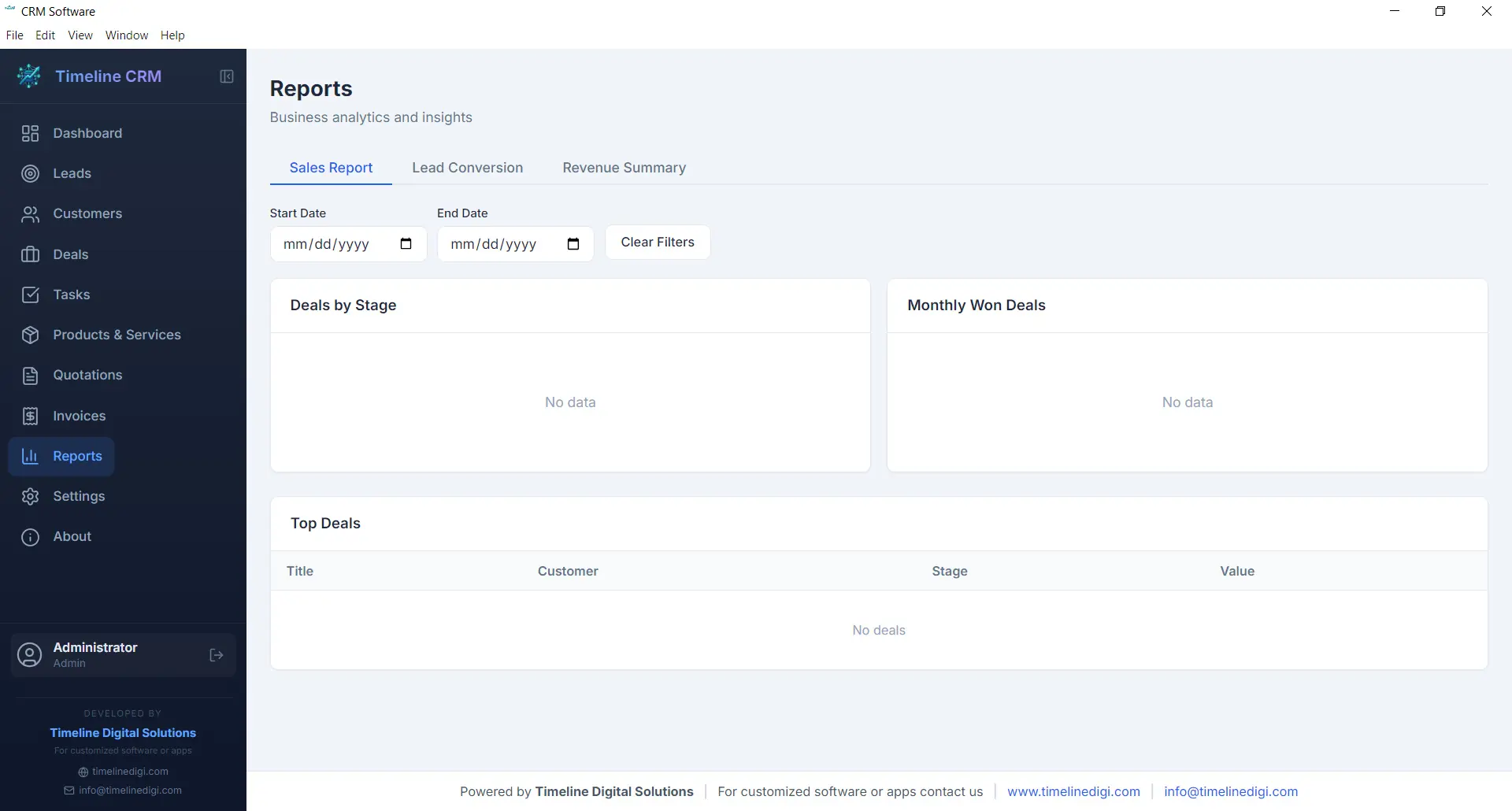
Data-driven decisions lead to better outcomes, and the Reports module gives you the insights you need without requiring a data analyst. Generate reports on sales performance, lead conversion rates, revenue trends, and pipeline health. Each report presents your data in clear, readable formats that help you understand what is working and what needs improvement.
Reports can be exported as CSV files for further analysis in spreadsheet applications or for sharing with business partners and accountants. Whether you need a monthly sales summary, a breakdown of deals by stage, or an overview of your lead sources, the Reports module produces the numbers you need to steer your business confidently.
- Sales performance and revenue reports
- Lead conversion and pipeline analysis
- CSV export for external analysis
- Visual charts and data summaries
Settings
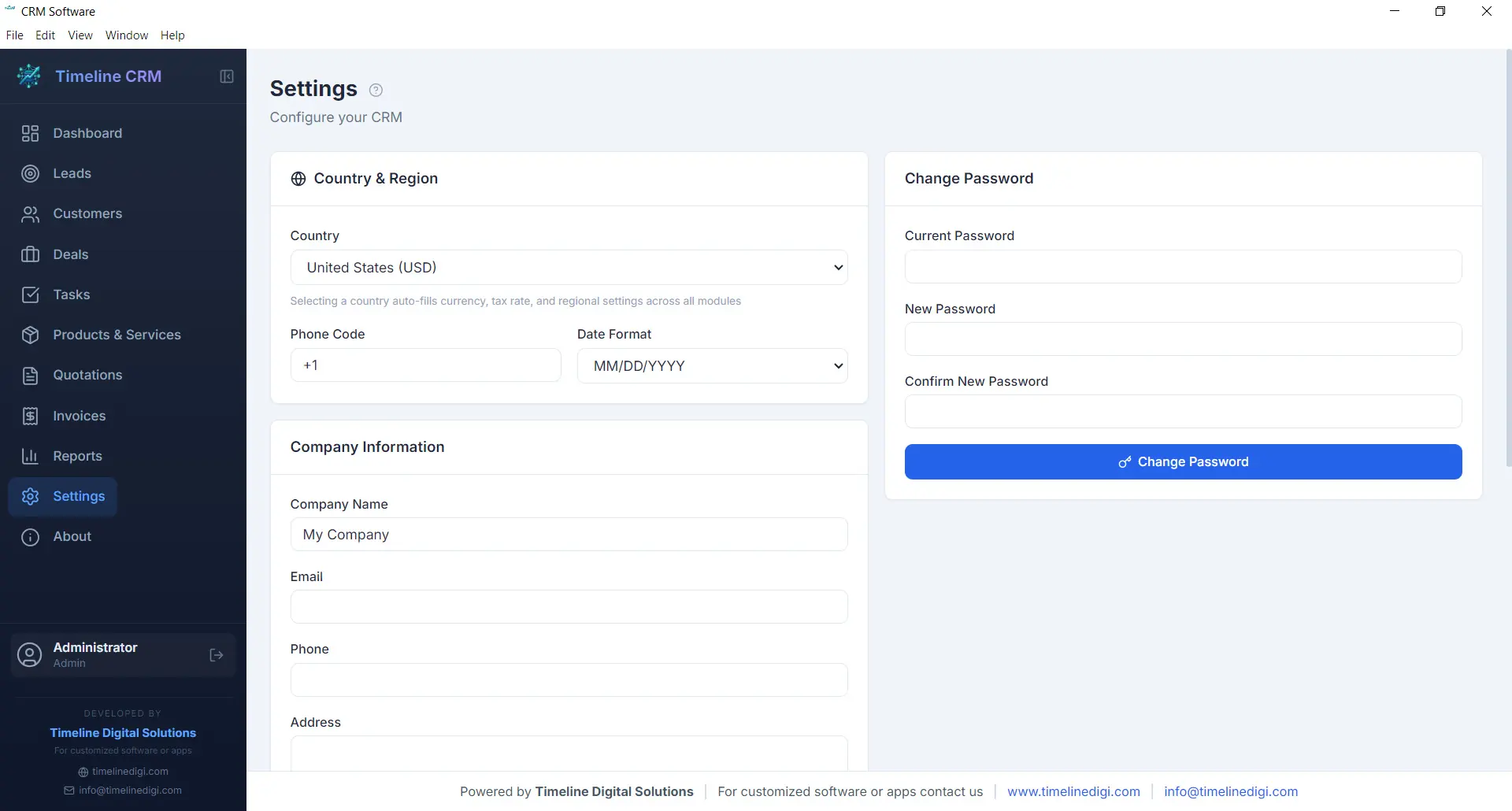
Every business has unique requirements, and the Settings module lets you tailor Timeline CRM to match yours. Configure your company name, logo, address, and contact details so that all generated documents — quotations and invoices — carry your branding. Set your preferred currency, tax rates, and country-based formatting to ensure financial calculations and number formats are correct for your region.
Customize auto-numbering prefixes for quotations and invoices to match your existing document numbering scheme. Adjust date formats, language preferences, and other display options to create a workspace that feels familiar and efficient. The Settings module is designed to be configured once and then work seamlessly in the background as you use every other module.
- Company profile and branding configuration
- Currency, tax, and country-based settings
- Auto-numbering prefix customization
- Date format and display preferences
Offline & Secure
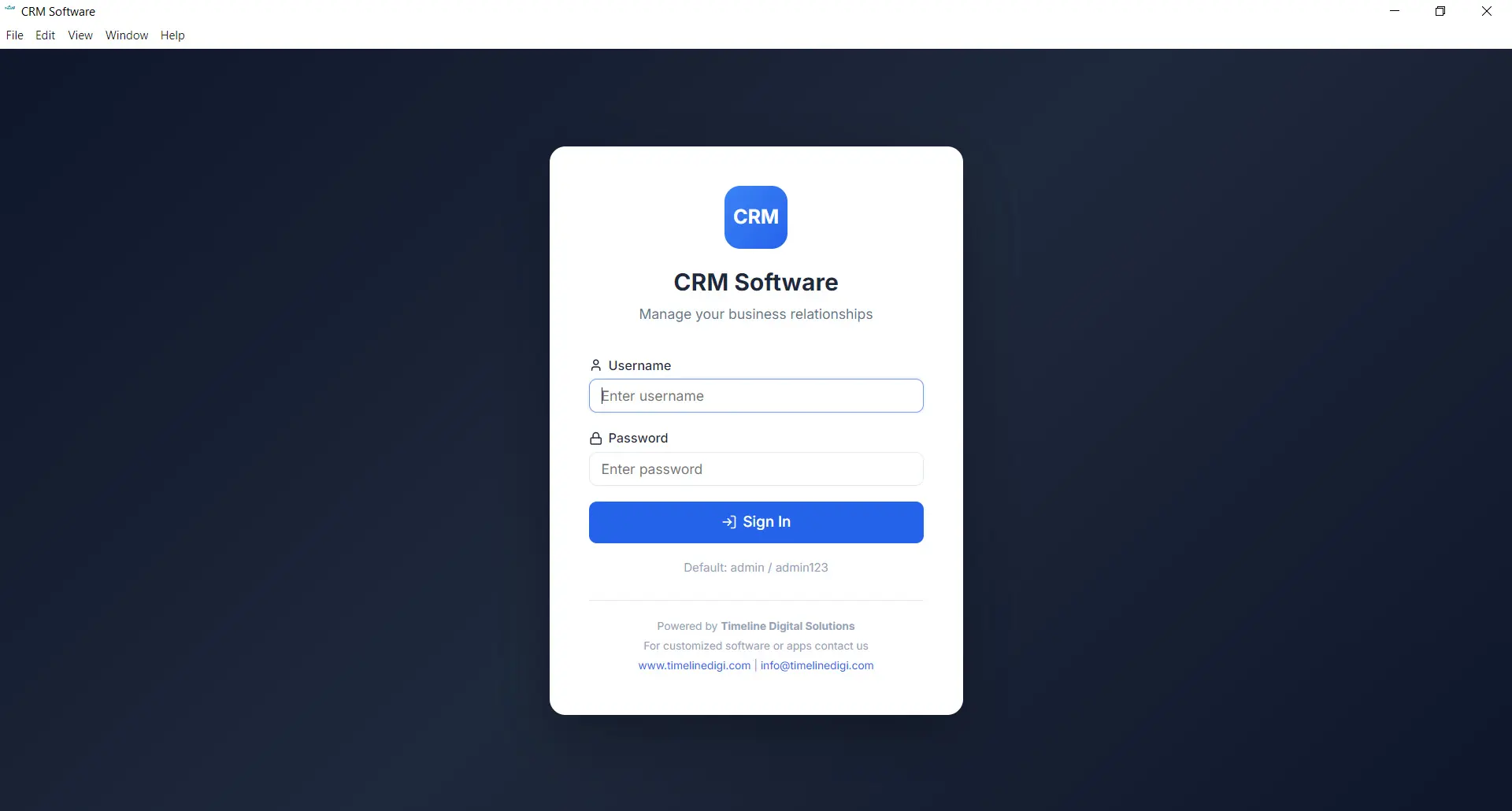
Privacy and data ownership are fundamental principles of Timeline CRM. Unlike cloud-based CRM systems that store your sensitive business data on third-party servers, Timeline CRM keeps everything on your local machine. The application uses SQLite as its database engine, storing all your leads, customers, deals, invoices, and other records in a single file on your hard drive that you fully control.
Because the application works entirely offline, you are never vulnerable to server outages, internet disruptions, or subscription cancellations that could lock you out of your own data. Your business information is always accessible, always private, and always yours. Back up your data by simply copying the database file, and rest assured that no one else has access to your customer information.
- 100% local data storage using SQLite
- No internet connection required
- No third-party data access or sharing
- Simple file-based backup and portability
All These Features. Completely Free.
Every module, every feature, every capability described above is included at no cost. Download Timeline CRM and start using all eleven modules today — no trial period, no feature restrictions, no credit card required.
Download Timeline CRM FreeVersion 1.0.0 • Windows 10/11 • 64-bit
See Timeline CRM in Action
Timeline CRM helps businesses manage leads, contacts, deals, quotations, invoices, and follow-ups in one place. Explore core workflows and compare related guides to choose the best setup for your team.