
Developed By
Timeline Digital Solutions
For customized software or apps, contact Timeline Digital Solutions. We build practical business software, CRM systems, and tailored digital tools for real-world business operations.
Best CRM Systems: Practical Comparison for Growth-Focused Teams
Searching for the best CRM systems can become overwhelming fast. Most comparison pages list dozens of tools but skip the hard truth: the right CRM system is not the one with the longest feature list, it is the one your team can actually adopt, sustain, and scale without operational drag. If a system is too expensive, too complex, or too disconnected from your daily sales process, it will underperform regardless of brand reputation.
This guide breaks down how to evaluate CRM systems with a decision framework that prioritizes real business outcomes. You will learn what to compare, where most teams make mistakes, and why Timeline CRM is a high-value option for businesses that want powerful CRM capabilities without recurring software costs.
What Makes the Best CRM Systems Different
The best CRM systems are operational systems, not just data repositories. They guide action, improve decision speed, and reduce friction in customer-facing workflows. At minimum, they provide structured lead management, relationship tracking, deal visibility, and follow-up execution. The strongest systems go further by connecting commercial documents, reporting insights, and accountability workflows into one practical interface.
A key differentiator is implementation realism. Many CRM systems look impressive in demos but demand heavy customization before teams can use them effectively. That delay creates hidden cost and slows ROI. High-performing CRM systems provide immediate baseline value with intuitive defaults and room to scale later. Teams should be productive in days, not months.
Another differentiator is data trust. If CRM data is incomplete or inconsistent, the system loses strategic value. Great CRM systems make updates easy, encourage consistent record hygiene, and support quick retrieval of account context during live customer conversations. This transforms CRM from passive storage into active relationship intelligence.
Finally, the best CRM systems align cost with value creation. Recurring fees are acceptable when they produce measurable gains. But if teams only use core features, a lower-cost or free system often delivers stronger ROI. Timeline CRM addresses this directly with complete core functionality and no subscription burden.
How to Compare CRM Systems with a 5-Point Framework
To choose among CRM systems confidently, use a structured framework instead of relying on vendor messaging. First, evaluate feature alignment. Map your current workflow and check whether each CRM covers those actions without paid add-ons. Focus on practical requirements like lead tracking, contact history, deal stages, task reminders, invoicing, and reporting.
Second, evaluate total ownership cost over three years. Include user licenses, premium tiers, implementation effort, migration, integrations, and training time. Many teams underestimate this by only comparing monthly base prices. Third, assess adoption friction. If the interface is hard to navigate, data quality drops and usage fades. Simplicity is a performance multiplier, especially in lean teams.
Fourth, review privacy and infrastructure fit. Cloud-first CRM systems may be ideal for distributed teams, while desktop-first systems can be better for privacy-sensitive operations and offline reliability. Fifth, test reporting usefulness. A CRM without practical analytics cannot support consistent improvement. You need visibility into follow-up discipline, pipeline movement, and conversion behavior.
This 5-point framework helps decision-makers avoid expensive mismatches. It prioritizes business fit over feature theater and leads to CRM choices that sustain value over time.
Best CRM Systems for Different Business Contexts
Different business models need different CRM strengths. Service businesses often prioritize account context and repeat interaction quality. Product teams may focus on pipeline velocity and revenue forecasting. Agencies typically require fast contact lookup, clear follow-up workflows, and efficient proposal-to-invoice transitions. The best CRM system is one that supports your dominant operating pattern with minimal configuration overhead.
For teams with strict compliance or privacy expectations, local data control can be a decisive factor. Desktop CRM systems reduce third-party data exposure and provide stronger ownership guarantees. For distributed global teams, cloud collaboration may outweigh local control. There is no universal winner. There is only fit relative to constraints and priorities.
Budget realities also matter. Many businesses select enterprise CRM platforms only to use 20 percent of available features while paying premium rates. In such cases, a focused system with complete core capabilities can produce better results at a fraction of cost. Timeline CRM reflects this approach by covering the full customer lifecycle without subscription pressure.
When evaluating best CRM systems, define your context first, then score options against that context. This prevents overbuying and improves implementation success.
Why Timeline CRM Is a High-Value Choice
Timeline CRM delivers what most small and mid-size teams need from best-in-class CRM systems: practical functionality, clear UX, and dependable performance. It includes lead and customer management, deal pipelines, tasks, quotations, invoices, products, reports, and settings in one coherent application. Teams can run core workflows without juggling disconnected tools.
Because Timeline CRM is desktop-first, it supports offline operation and local data ownership. This is especially valuable for field teams, low-connectivity environments, and privacy-conscious organizations. Instead of relying on remote infrastructure, teams can continue working with full functionality from their Windows systems.
The pricing model is another major advantage. Timeline CRM is free, which removes annual budget pressure and allows teams to allocate resources toward growth activities. Free does not mean limited here. Core modules are fully available, making it a realistic long-term system rather than a temporary trial tool.
For businesses that need dependable CRM capability without enterprise complexity, Timeline CRM represents one of the strongest value propositions in today’s CRM market.
Frequently Asked Questions
What are the best CRM systems for small businesses?
The best CRM systems combine workflow fit, practical pricing, easy adoption, and clear reporting. Timeline CRM is a strong option for teams that want full core CRM capability without subscription cost.
How should I compare CRM systems?
Use a framework: feature fit, total cost, usability, data model, and reporting quality. This helps you choose a system that sustains value beyond the first month.
Are free CRM systems reliable?
Yes, if they provide complete core workflows and stable architecture. Timeline CRM is built for real operations and includes lead, customer, deal, and reporting modules.
Can CRM systems improve forecasting?
Yes. Structured pipeline stages and activity tracking improve revenue forecasting by making opportunity status and momentum visible.
Choose a CRM System That Your Team Will Actually Use
Pick a system that matches your real workflow, protects your data, and delivers consistent value without unnecessary complexity.
Get Timeline CRM Free
Every Feature You Need,
Zero Cost
Timeline CRM packs a complete suite of business management tools into one free desktop application. From lead capture to invoice generation, every module is designed to help small businesses operate more efficiently without paying for expensive cloud subscriptions.
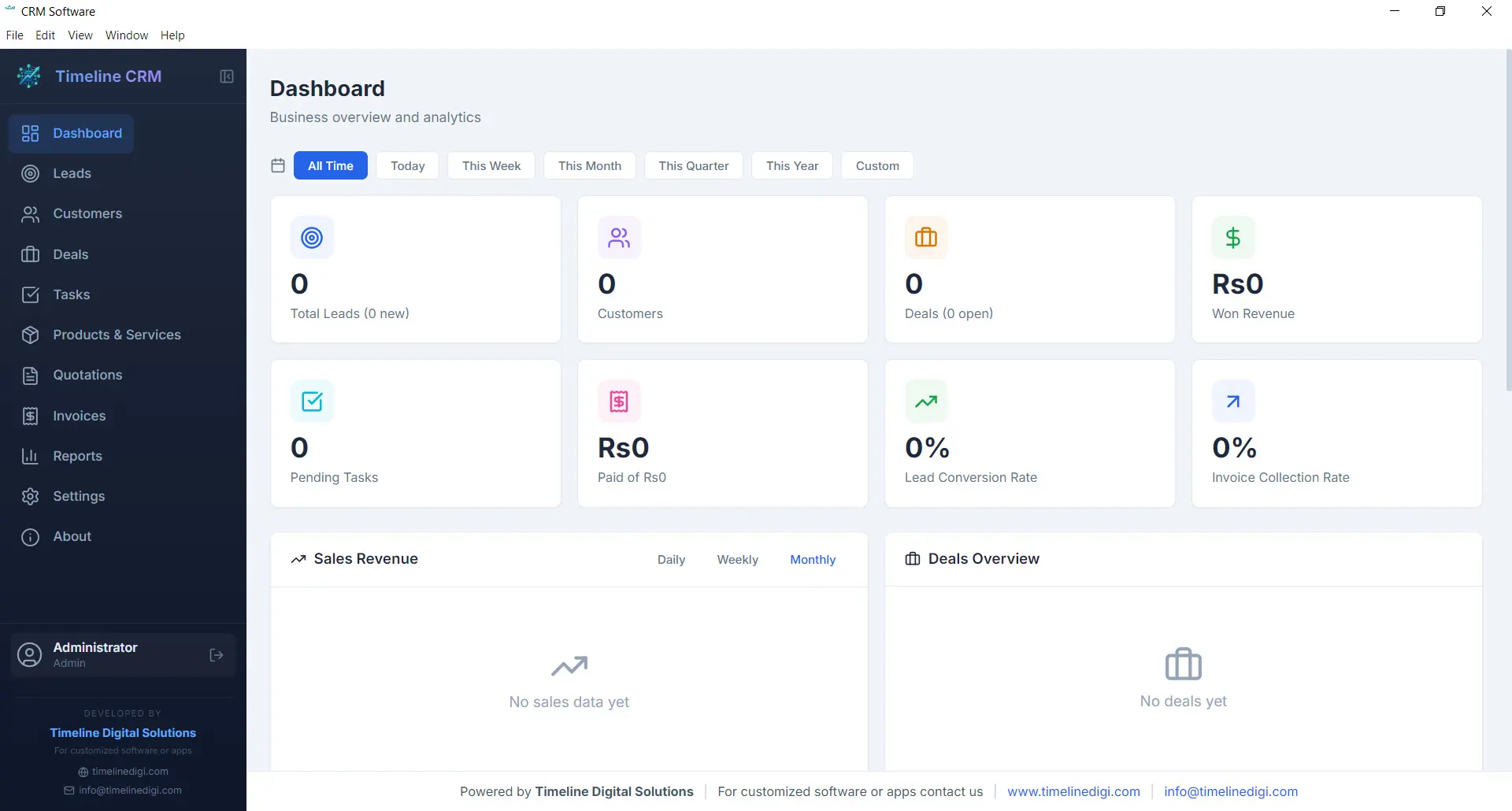
Dashboard
The Dashboard is your command center. Every time you open Timeline CRM, you are greeted with a comprehensive overview of your business performance. Key metrics are displayed prominently so you can gauge the health of your sales pipeline, track revenue trends, and identify areas that need attention — all without clicking through multiple screens.
Visual charts and summary cards present your data in an easy-to-digest format. Whether you want to see how many new leads came in this week, what your total deal value looks like, or which tasks are overdue, the Dashboard surfaces that information instantly. It is the first thing you see and the fastest way to stay on top of your business.
- Real-time business metrics and KPI cards
- Sales pipeline distribution chart
- Recent activity feed and upcoming tasks
- Revenue and lead trend visualizations
Leads
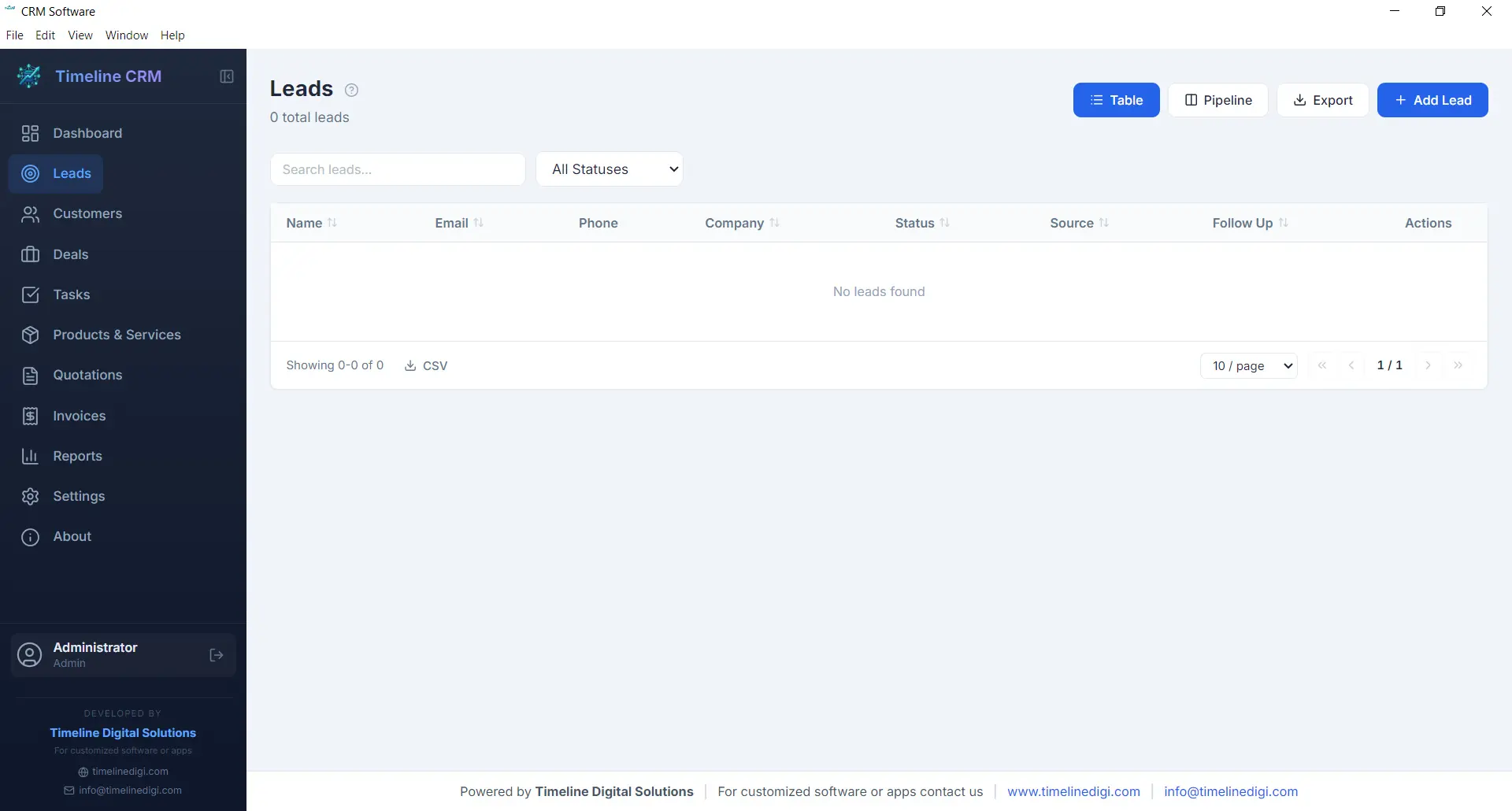
The Leads module is where every potential customer relationship begins. Capture new leads with detailed contact information, company details, and source tracking. Each lead is placed into a structured seven-stage pipeline — New, Contacted, Qualified, Proposal, Negotiation, Won, and Lost — so you always know exactly where every prospect stands in your sales process.
As you work with each lead, you can log phone calls, record meeting notes, attach documents, and track every interaction. This complete history ensures that no context is lost when you follow up days or weeks later. The pipeline view gives you a visual representation of your entire lead funnel, making it easy to spot bottlenecks and prioritize your outreach efforts.
- Seven-stage pipeline: New, Contacted, Qualified, Proposal, Negotiation, Won, Lost
- Call logging with date, duration, and notes
- Lead source and priority tracking
- Convert leads to customers with one click
Customers
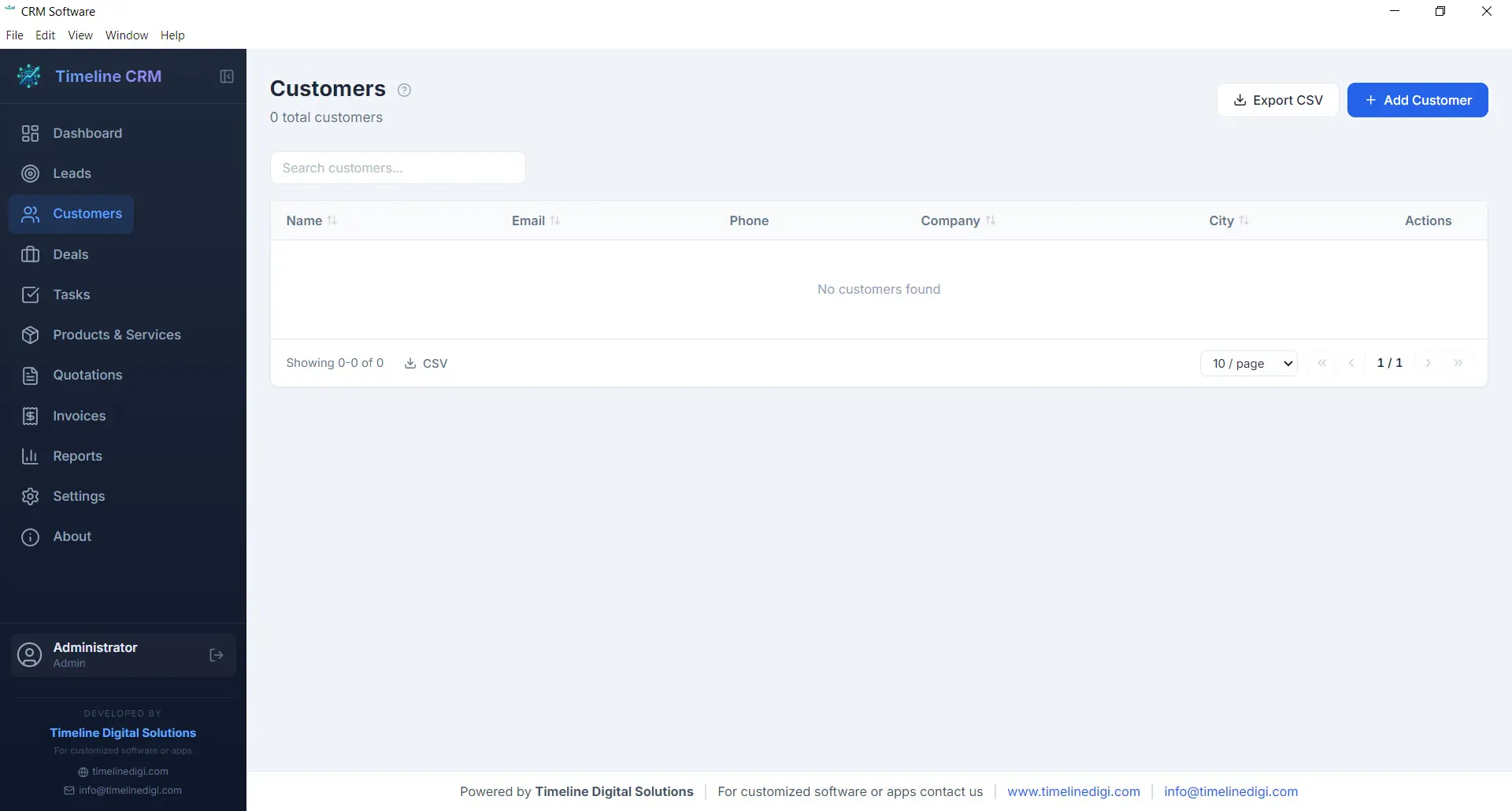
Your customers are the backbone of your business, and the Customers module helps you manage every relationship with care. Store comprehensive contact information, company details, billing addresses, and communication preferences in one organized record. When a lead is converted to a customer, all their history transfers automatically so nothing is lost in the transition.
Each customer profile acts as a hub connecting all related business data. Open any customer record and you can instantly view their associated deals, outstanding invoices, past quotations, and every note or interaction logged over time. This 360-degree view enables you to provide better service, anticipate needs, and build long-term relationships that drive repeat business.
- Complete contact and company profiles
- Full interaction and transaction history
- Linked deals, invoices, and quotations
- CSV export for customer data
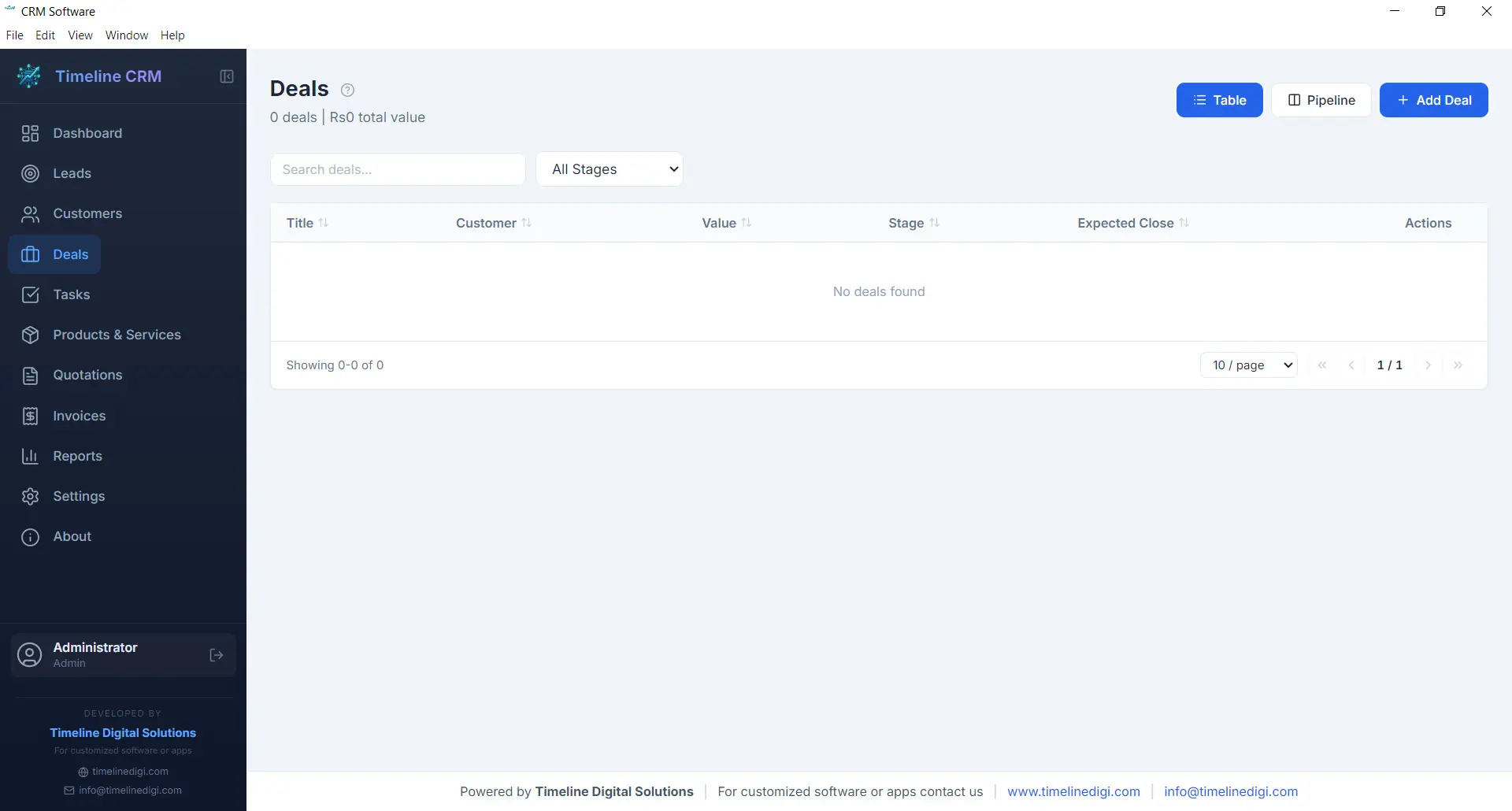
Deals
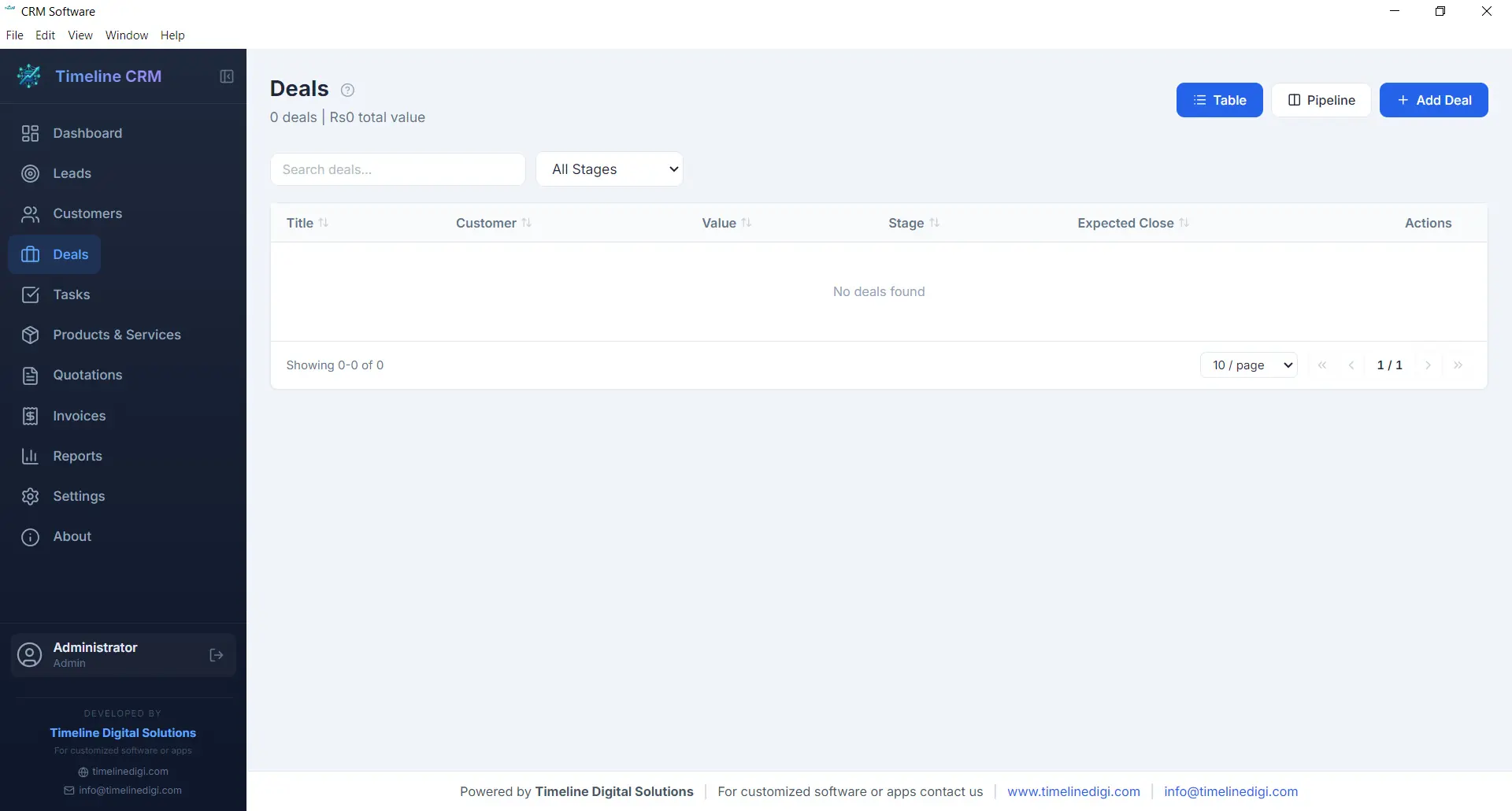
The Deals module tracks every sales opportunity from first conversation to closed contract. Each deal is assigned a monetary value, an expected close date, and a probability percentage, giving you accurate revenue forecasting at all times. The six-stage pipeline — Prospect, Qualification, Proposal, Negotiation, Won, and Lost — provides a clear visual workflow that keeps your sales process structured and predictable.
Deals are linked to specific customers and can reference related quotations, making it easy to track the progression from initial quote to final agreement. You can add notes, update stages with a single click, and monitor your weighted pipeline value to understand projected revenue. For business owners who need clarity on what money is coming in and when, the Deals module delivers that visibility.
- Six-stage pipeline: Prospect, Qualification, Proposal, Negotiation, Won, Lost
- Deal value, probability, and expected close date
- Revenue forecasting with weighted pipeline
- Linked to customers and quotations
Tasks
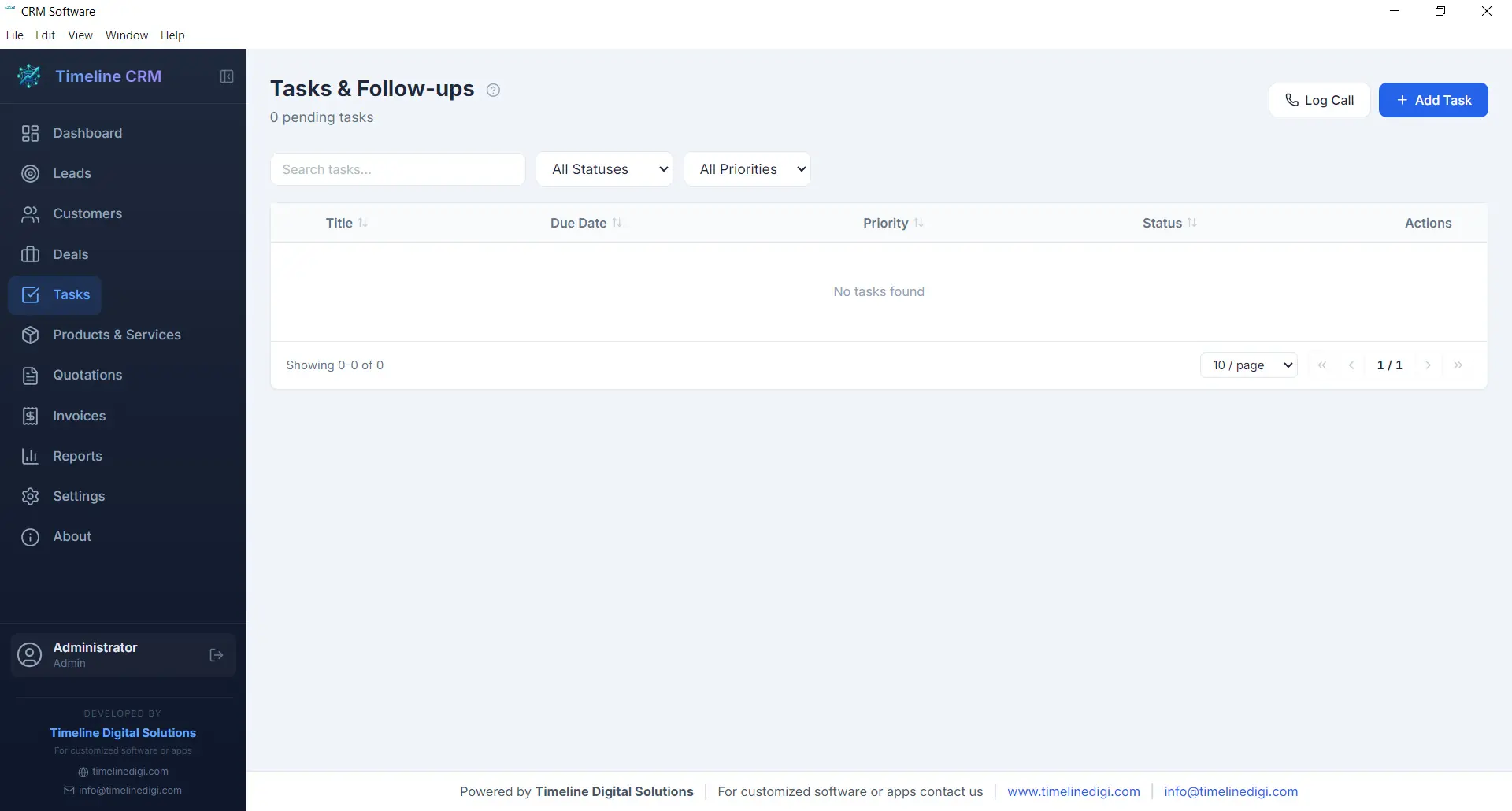
Staying organized is essential when you are managing multiple leads and deals simultaneously. The Tasks module gives you a straightforward way to create, prioritize, and track action items that keep your business moving forward. Each task can include a title, description, due date, priority level, and status, making it easy to see what needs attention right now.
Tasks can be linked to specific leads, customers, or deals, providing context about why the task exists and what it relates to. Whether you need to follow up with a prospect, prepare a proposal, or review an invoice, the Tasks module ensures nothing slips through the cracks. Overdue tasks are highlighted on the Dashboard so you can take action before opportunities are missed.
- Create tasks with due dates and priority levels
- Link tasks to leads, customers, or deals
- Status tracking: pending, in progress, completed
- Overdue task alerts on the Dashboard
Products
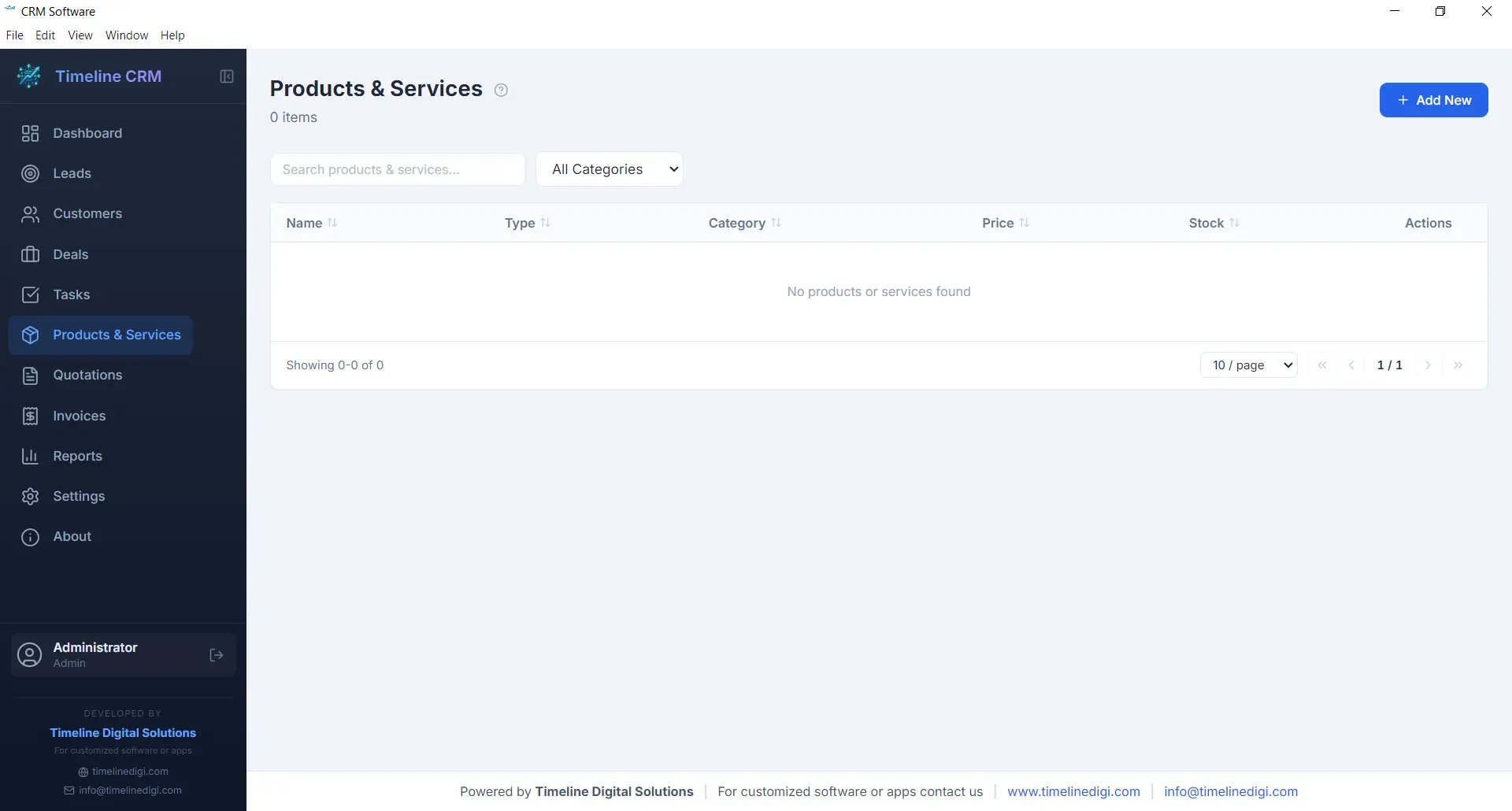
The Products module serves as your centralized catalog for everything your business sells, whether physical products, services, or subscription packages. Each product entry includes a name, description, unit price, and category, allowing you to build a well-organized inventory that feeds directly into your quotations and invoices.
Having a product catalog eliminates the repetitive task of manually entering item details every time you create a new quotation or invoice. Simply select products from your catalog, specify quantities, and the system handles the rest — including price calculations and line item formatting. This saves time, reduces errors, and ensures consistency across all your business documents.
- Centralized product and service catalog
- Name, description, price, and category fields
- Direct integration with quotations and invoices
- Unlimited product entries
Quotations
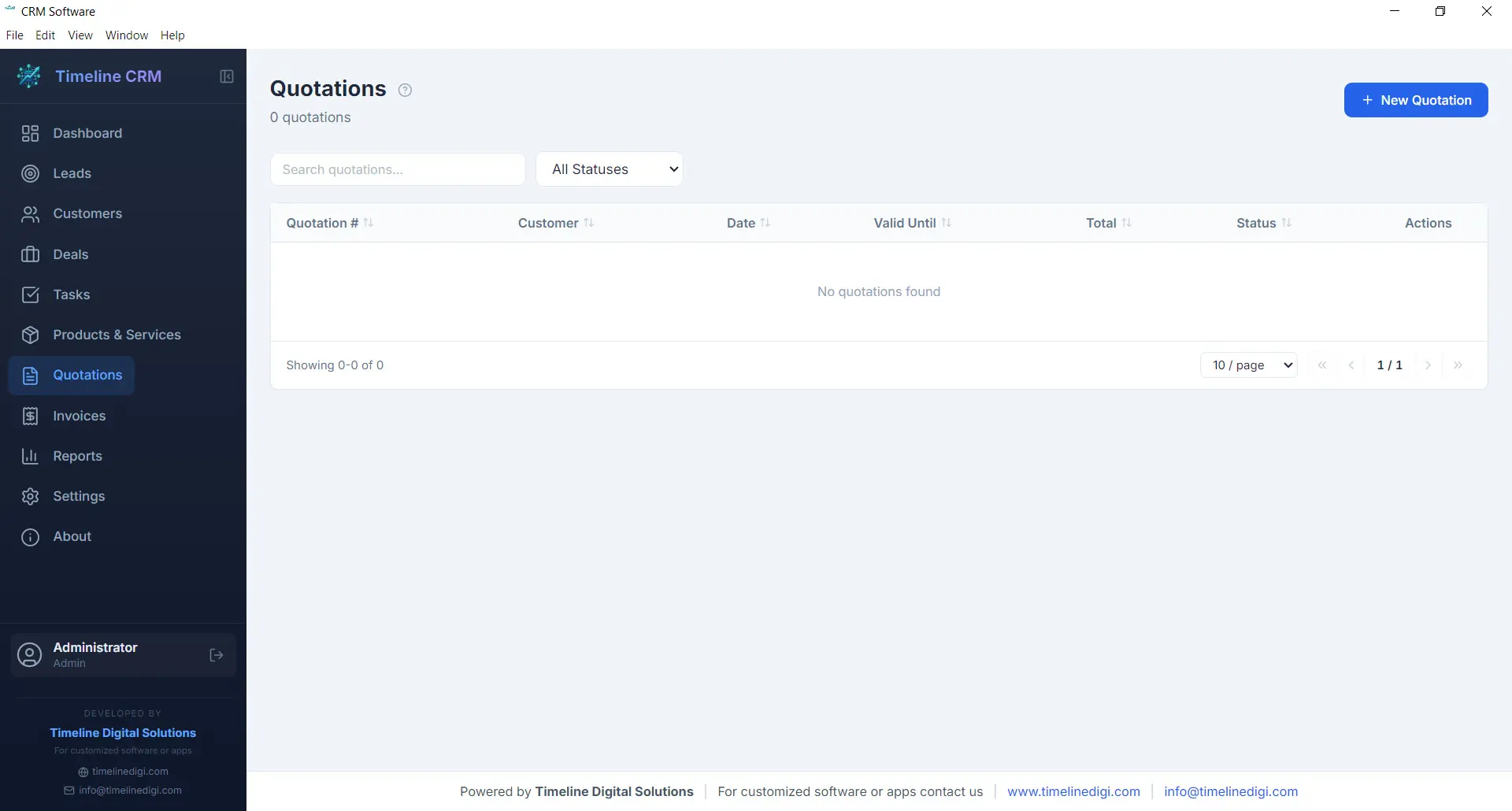
When a prospect is ready to hear your pricing, the Quotations module helps you respond quickly with a professional, branded document. Create quotations by selecting a customer, adding line items from your product catalog, adjusting quantities and pricing as needed, and generating a polished PDF in seconds. Auto-numbering ensures every quotation has a unique reference number for easy tracking.
Each quotation records the creation date, validity period, total amount, and current status. You can track whether a quote is pending, accepted, or rejected, giving you clear visibility into your conversion rates. Quotations can be linked to specific deals, so when a prospect accepts your quote, you can update the deal stage and move seamlessly toward closing the sale.
- Professional PDF quotation generation
- Auto-numbering with customizable prefix
- Line items from product catalog with quantity and pricing
- Status tracking: pending, accepted, rejected
Invoices
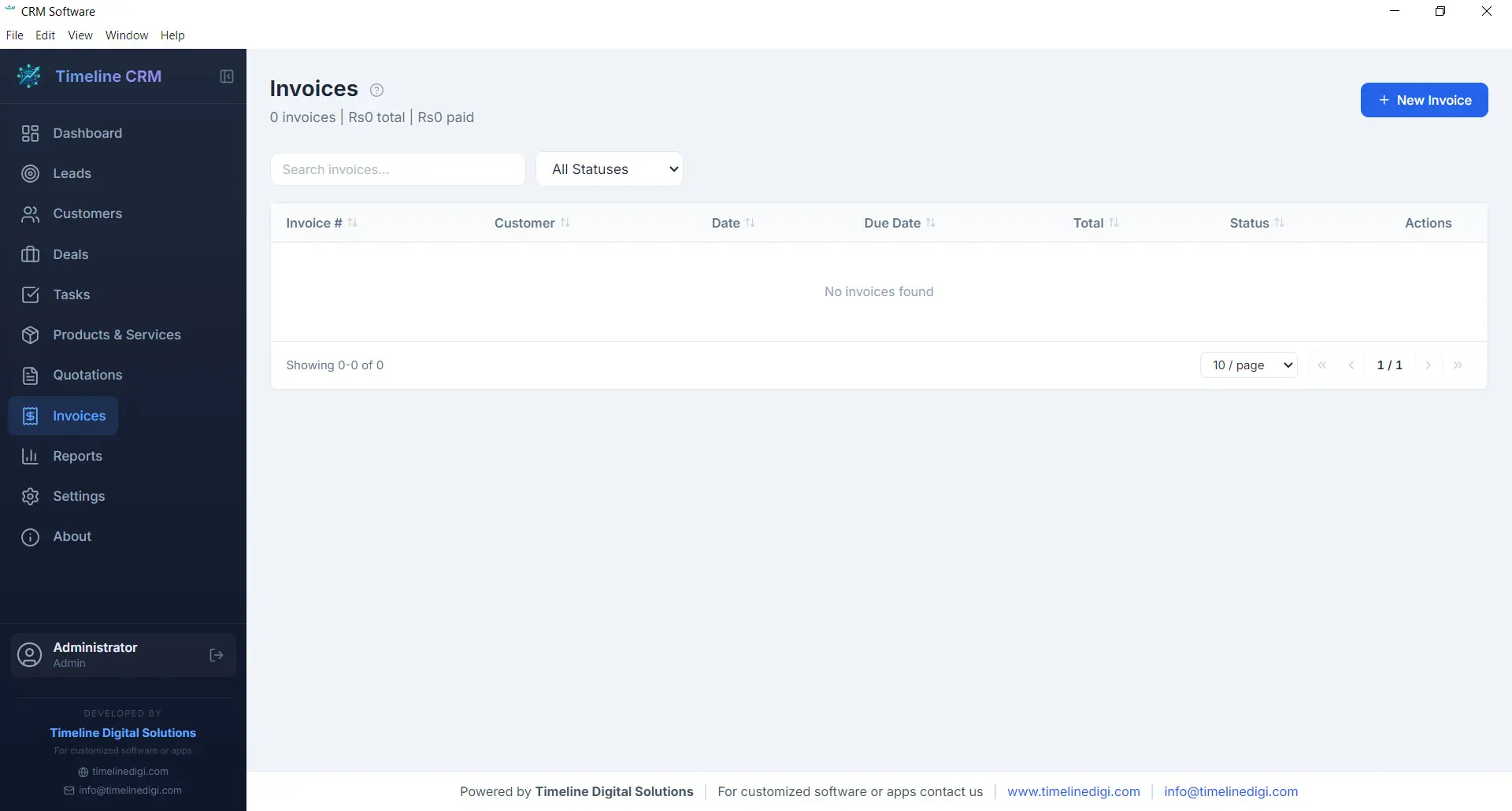
The Invoices module streamlines your billing workflow from creation to payment tracking. Generate detailed invoices with line items pulled from your product catalog, automatic tax calculations based on your configured rates, and professional formatting that represents your business well. Every invoice receives a unique auto-generated number for organized record keeping.
Track the payment status of each invoice — whether it is unpaid, partially paid, or fully settled — so you always know where your receivables stand. Export invoices as PDF documents to share with customers via email or print. The invoicing module works hand-in-hand with your customer and deal records, keeping your financial data connected to the rest of your business operations.
- PDF invoice generation with professional formatting
- Automatic tax calculations
- Payment status tracking: unpaid, partial, paid
- Auto-numbering with customizable prefix
Reports
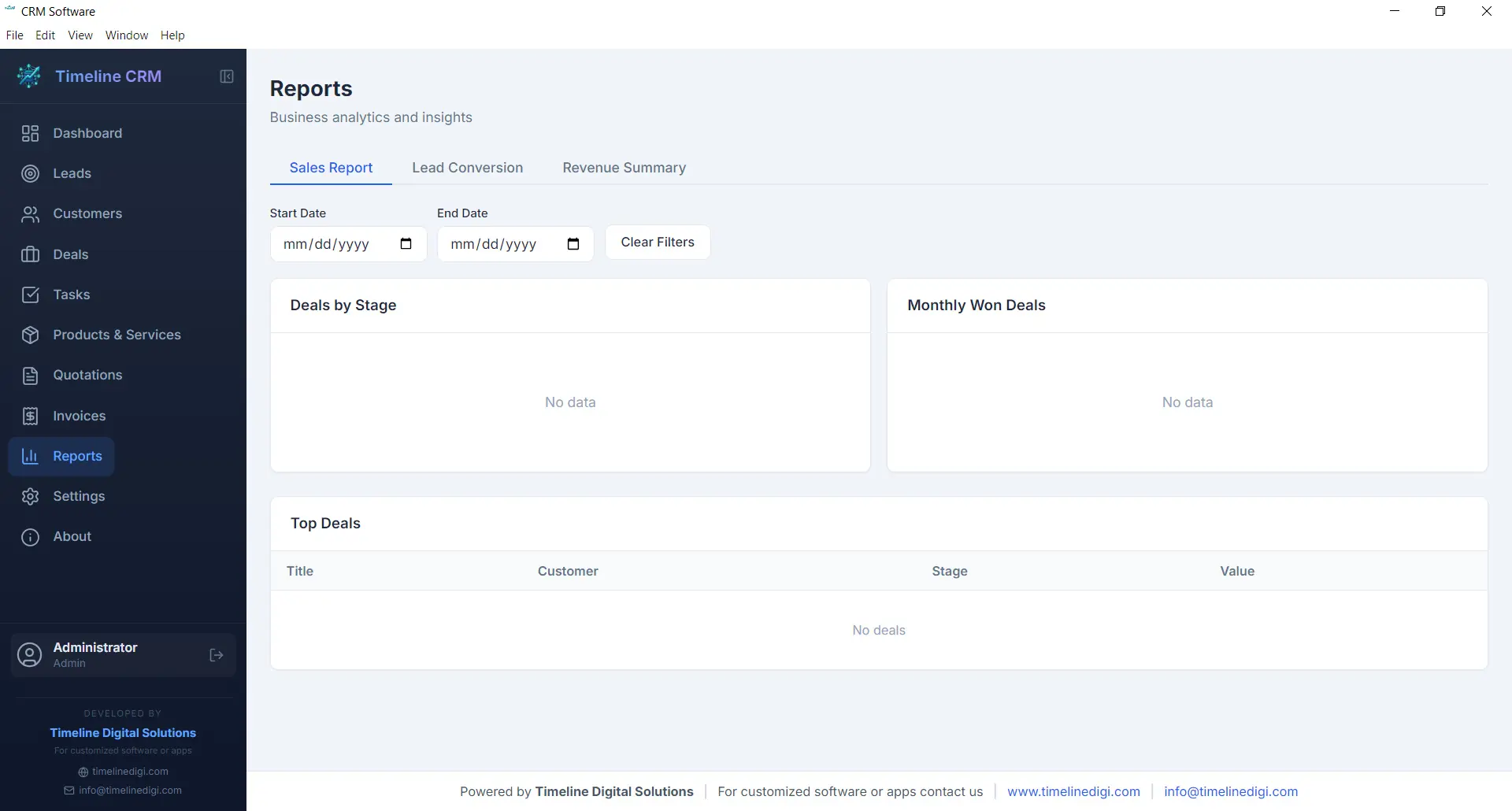
Data-driven decisions lead to better outcomes, and the Reports module gives you the insights you need without requiring a data analyst. Generate reports on sales performance, lead conversion rates, revenue trends, and pipeline health. Each report presents your data in clear, readable formats that help you understand what is working and what needs improvement.
Reports can be exported as CSV files for further analysis in spreadsheet applications or for sharing with business partners and accountants. Whether you need a monthly sales summary, a breakdown of deals by stage, or an overview of your lead sources, the Reports module produces the numbers you need to steer your business confidently.
- Sales performance and revenue reports
- Lead conversion and pipeline analysis
- CSV export for external analysis
- Visual charts and data summaries
Settings
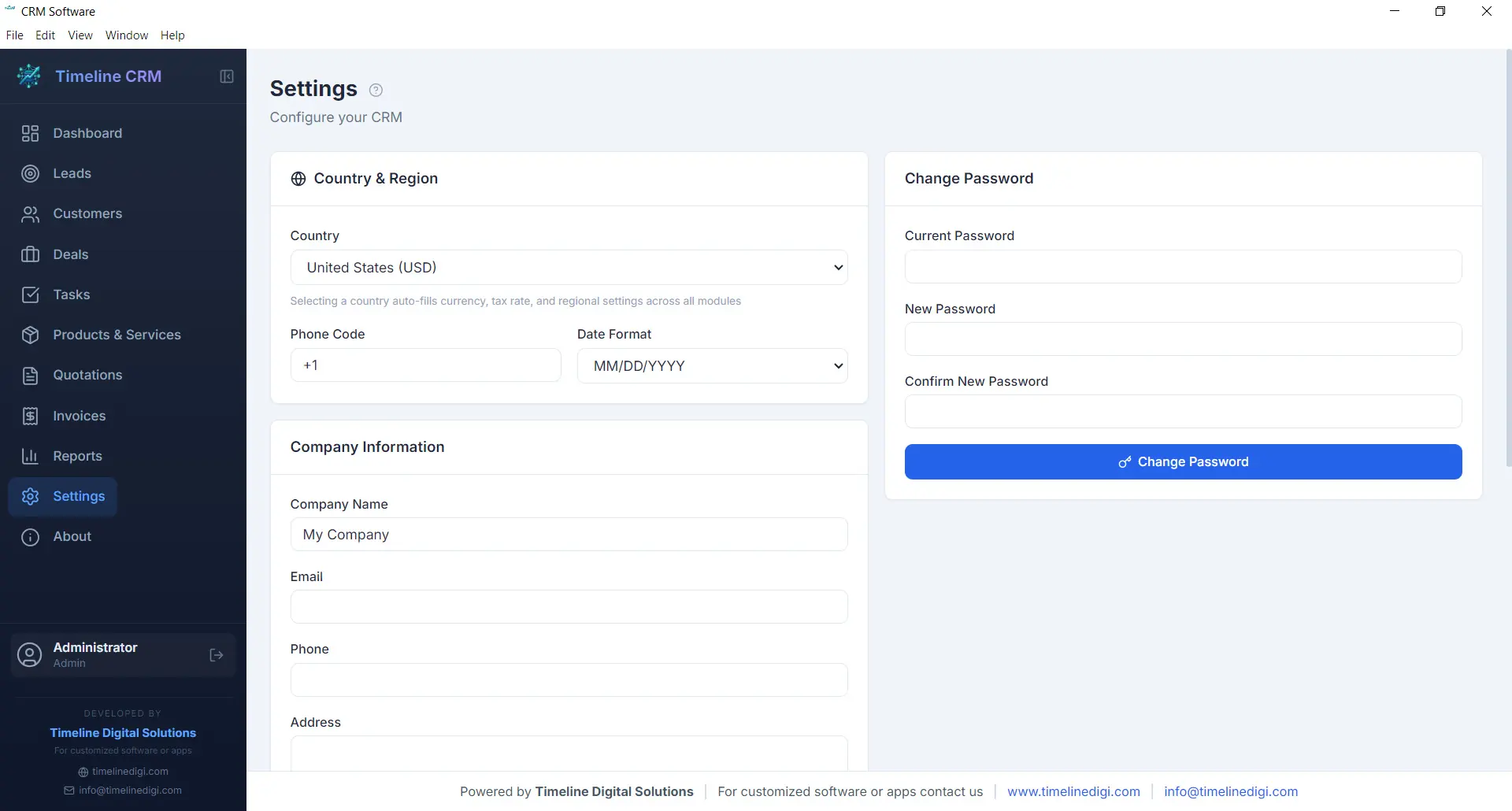
Every business has unique requirements, and the Settings module lets you tailor Timeline CRM to match yours. Configure your company name, logo, address, and contact details so that all generated documents — quotations and invoices — carry your branding. Set your preferred currency, tax rates, and country-based formatting to ensure financial calculations and number formats are correct for your region.
Customize auto-numbering prefixes for quotations and invoices to match your existing document numbering scheme. Adjust date formats, language preferences, and other display options to create a workspace that feels familiar and efficient. The Settings module is designed to be configured once and then work seamlessly in the background as you use every other module.
- Company profile and branding configuration
- Currency, tax, and country-based settings
- Auto-numbering prefix customization
- Date format and display preferences
Offline & Secure
Privacy and data ownership are fundamental principles of Timeline CRM. Unlike cloud-based CRM systems that store your sensitive business data on third-party servers, Timeline CRM keeps everything on your local machine. The application uses SQLite as its database engine, storing all your leads, customers, deals, invoices, and other records in a single file on your hard drive that you fully control.
Because the application works entirely offline, you are never vulnerable to server outages, internet disruptions, or subscription cancellations that could lock you out of your own data. Your business information is always accessible, always private, and always yours. Back up your data by simply copying the database file, and rest assured that no one else has access to your customer information.
- 100% local data storage using SQLite
- No internet connection required
- No third-party data access or sharing
- Simple file-based backup and portability
All These Features. Completely Free.
Every module, every feature, every capability described above is included at no cost. Download Timeline CRM and start using all eleven modules today — no trial period, no feature restrictions, no credit card required.
Download Timeline CRM FreeVersion 1.0.0 • Windows 10/11 • 64-bit