
Best CRM Software of 2025 — Find the Right CRM for Your Business
Choosing the best CRM is one of the most impactful decisions a growing business can make. A strong customer relationship management platform organizes every contact, tracks every deal through your pipeline, automates invoicing, and delivers the reporting insights you need to make smarter decisions. But with hundreds of CRM solutions on the market — each claiming to be the best — how do you separate genuine value from marketing hype? The answer lies in evaluating what actually matters: total cost of ownership, feature depth for your specific workflow, data privacy and security, ease of setup, and whether the software works reliably when you need it most. Many businesses discover too late that the CRM they chose charges escalating per-user fees, locks essential features behind premium tiers, or requires a constant internet connection just to access their own customer data. Timeline CRM was built to eliminate those frustrations entirely. It is a completely free desktop CRM for Windows that gives you all 11 modules — from lead and deal pipelines to invoicing and analytics — with no subscriptions, no contact limits, and full offline access. In this guide, we break down exactly what makes the best CRM, compare the leading approaches, and show you why Timeline CRM deserves a spot at the top of your shortlist.
Developed By
Timeline Digital Solutions
For customized software or apps, contact Timeline Digital Solutions. We build practical business software, CRM systems, and tailored digital tools for real-world business operations.
Table of Contents
What Makes the Best CRM Software?
The best CRM software is not simply the one with the longest feature list or the biggest marketing budget. It is the platform that fits your team's actual workflow, grows with your business, and delivers measurable return on investment without draining your budget through escalating subscription fees. At its core, outstanding CRM software should centralize all customer interactions in one place, give you visual pipeline management to track deals from initial contact to closed revenue, and provide clear reporting so you understand which activities drive results.
Ease of adoption is equally critical. Research consistently shows that CRM implementations fail not because the software lacks features but because teams resist using overly complex tools. The best CRM minimizes the learning curve with intuitive interfaces, logical navigation, and sensible defaults that work out of the box. You should be managing contacts and tracking deals within minutes of installation, not weeks of configuration. Speed of daily use matters too — a CRM that loads slowly or requires constant internet connectivity introduces friction that discourages consistent usage. Desktop CRM applications excel here because they run natively on your machine, accessing a local database with near-instant response times regardless of your internet connection quality.
Finally, the best CRM respects your autonomy. Your customer data belongs to you, not to a vendor who might change pricing, shut down their service, or suffer a data breach. A truly top-tier CRM gives you full ownership of your information, straightforward data export capabilities, and zero vendor lock-in. These principles guided the creation of Timeline CRM, which stores everything locally on your Windows PC in a SQLite database you fully control.
Comparing CRM Pricing Models and Hidden Costs
CRM pricing is where many businesses encounter unpleasant surprises. Most popular CRM platforms use a per-user, per-month subscription model that appears affordable initially but compounds rapidly as your team grows. A CRM that costs $30 per user per month adds up to $1,800 annually for a five-person team — and that figure often excludes add-ons for advanced reporting, additional storage, phone integrations, or premium support. Enterprise tiers from major vendors can reach $150 to $300 per user monthly, making CRM one of the most expensive line items in a growing company's software budget.
Freemium models present their own challenges. Several well-known CRMs offer a free tier, but these almost always impose restrictions designed to push you toward paid plans: caps on the number of contacts, limited pipeline stages, no invoicing, restricted reporting, or watermarked documents. Once you have invested weeks or months importing data and building workflows on the free tier, migrating away when you hit the paywall becomes painful. This is deliberate vendor lock-in disguised as generosity.
Timeline CRM eliminates the entire pricing conversation. It is free — genuinely, permanently free. There are no premium tiers, no per-user fees, no contact caps, and no feature restrictions. Because it runs as a desktop application on your Windows computer using a local SQLite database, there are no cloud hosting costs that need to be subsidized through subscriptions. You download it, install it, and gain immediate access to every module. The total cost of ownership over one year, five years, or ten years is exactly zero dollars. For small businesses and solo entrepreneurs watching every expense, this represents a fundamentally different value proposition compared to subscription CRM platforms.
Essential Features Every Top CRM Must Have
When evaluating CRM software, features should map directly to real business activities rather than being checkboxes on a comparison chart. The foundation of any worthwhile CRM is robust contact management — the ability to store, search, and organize every customer, prospect, and vendor with complete interaction histories. On top of that foundation, visual pipeline management is essential. Kanban-style boards let you drag deals through stages, giving you an immediate picture of your sales funnel's health and identifying bottlenecks before they cost you revenue.
Beyond pipeline tracking, the best CRMs streamline the revenue side of your business with built-in invoicing and quotation generation. Creating professional documents with auto-numbering and PDF export directly within your CRM eliminates the need for separate billing software and ensures that financial records stay connected to the customer record they belong to. Task management keeps your team accountable by associating follow-ups and deadlines with specific contacts or deals, preventing leads from falling through the cracks.
Reporting and analytics round out the essential feature set. You need dashboards that show pipeline value, conversion rates, revenue trends, and activity summaries without requiring you to manually export spreadsheets and build pivot tables. Timeline CRM delivers every one of these capabilities across its 11 integrated modules. Its 7-stage lead pipeline and 6-stage deal pipeline provide granular tracking, while the quotation and invoice modules handle document generation with payment status tracking — all within a single, cohesive application that runs entirely on your desktop.
What the Best CRM Delivers
Visual Pipeline Management
Kanban drag-and-drop boards with customizable stages let you see every deal's status at a glance. Timeline CRM offers a 7-stage lead pipeline and a 6-stage deal pipeline for granular tracking.
Complete Contact Database
Store unlimited contacts with full interaction histories, call logs, and notes. Organize customers, leads, and vendors in a single searchable database with no record limits.
Invoice and Quotation Generation
Create professional invoices and quotations with auto-numbering and PDF export. Track payment statuses and link financial documents directly to customer records for seamless accounting.
Task and Follow-Up Tracking
Assign tasks with deadlines and priorities to ensure no lead goes unfollowed. Associate tasks with specific contacts or deals to maintain context and accountability across your pipeline.
Reports and Analytics
Dashboard summaries, pipeline breakdowns, conversion metrics, and revenue analytics help you make data-driven decisions without exporting to spreadsheets or third-party tools.
Zero Cost, Full Access
No subscriptions, no per-user fees, no premium tiers. Timeline CRM gives you complete access to all 11 modules permanently free. Your investment is zero dollars today and every day after.
Data Privacy and Security in CRM Selection
In an era of increasing data breaches and stricter privacy regulations, where you store your customer data is no longer a secondary consideration — it is a primary evaluation criterion. Cloud-based CRMs transmit your entire customer database to third-party servers, often distributed across multiple data centers in different jurisdictions. While reputable cloud vendors invest heavily in security, the fundamental reality is that your sensitive business information resides on infrastructure you do not control. Any breach of the vendor's systems exposes your data, your customers' information, and potentially your regulatory compliance.
Desktop CRM applications like Timeline CRM take an architecturally different approach to security. All data stays on your local machine in a SQLite database file that never leaves your computer unless you explicitly choose to move it. There are no cloud syncing mechanisms, no third-party servers processing your information, and no authentication tokens traveling across the internet. This local-first architecture means your customer records are protected by your own security measures — your operating system passwords, your disk encryption, your physical access controls. For businesses handling sensitive client information, professional services firms, healthcare-adjacent businesses, or any organization that prefers to keep customer data under their own roof, this is a significant advantage.
Data portability completes the privacy picture. The best CRM never holds your data hostage. Timeline CRM supports CSV export for any data set and generates standardized PDF documents for invoices and quotations. You always retain full control and ownership, with no vendor lock-in trapping you if your needs change in the future.
Why Timeline CRM Ranks Among the Best
Timeline CRM, developed by Timeline Digital Solutions, earns its place among the best CRM solutions by excelling in the criteria that matter most: comprehensive features, zero cost, absolute data privacy, and effortless setup. While other platforms may offer a broader ecosystem of integrations and cloud collaboration tools, Timeline CRM focuses on delivering the core CRM functionality that drives daily business results — and it does so without charging a single dollar or requiring an internet connection.
The application includes 11 fully integrated modules. The Dashboard gives you an immediate overview of your pipeline health and key metrics. Leads management features a 7-stage pipeline with Kanban drag-and-drop boards for visual tracking. The Customers module provides a complete database with interaction histories and call logging. Deals tracking offers a separate 6-stage pipeline for managing opportunities through your sales process. Tasks keep your follow-ups organized with deadlines and priorities. The Products module catalogs your offerings so they can be quickly added to quotations and invoices. Quotations feature auto-numbering and professional PDF export. Invoices include payment tracking and PDF generation. Reports and Analytics provide visual dashboards with conversion metrics and revenue summaries. Settings let you customize the application to match your workflow. And all of this operates entirely offline with local SQLite storage for complete data security.
Built with Electron and React, Timeline CRM delivers a modern, responsive user interface that feels polished and professional. It installs in under two minutes on Windows 10 or 11, requires no account creation, no server configuration, and no technical expertise. For businesses that want a best-in-class CRM experience without the cost or complexity of enterprise platforms, Timeline CRM version 1.0.0 is a standout choice.
Getting Started with the Best CRM for Free
Getting up and running with Timeline CRM takes less time than filling out a registration form for most cloud CRM platforms. Visit the download page, grab the installer for Windows 10 or 11 (64-bit), and run the setup. The entire installation completes in under two minutes. There is no account creation step, no email verification, and no credit card request. Once the application launches, you are immediately inside a fully functional CRM with all 11 modules available.
Start by navigating to the Settings module to configure your business name and basic preferences. Then head to the Leads section to add your first prospects. The Kanban board lets you drag leads through seven stages as they progress toward becoming customers. When a lead converts, move them to the Customers module where their full history is preserved. Create deals in the Deals pipeline to track revenue opportunities through six stages. Use the Products module to set up your catalog, then generate Quotations and Invoices directly from your customer and deal records, complete with auto-numbering and PDF export.
As your data accumulates, the Reports and Analytics module delivers visual insights into your pipeline performance, revenue trends, and conversion rates. Every interaction, from the first lead capture to the final invoice payment, lives in one unified system running entirely on your machine. No monthly fees will ever interrupt your workflow, no internet outage will lock you out, and no vendor policy change will restrict your access. That is what the best CRM looks like in 2025.
Frequently Asked Questions About the Best CRM
What makes the best CRM software in 2025? ▾
The best CRM software in 2025 combines intuitive pipeline management, contact organization, invoicing, task automation, and reporting in a single platform. It should be easy to set up, affordable or free, secure with your data, and adaptable to your specific sales workflow without requiring weeks of training or costly consultants.
Is a free CRM as good as a paid CRM? ▾
For many small and mid-sized businesses, a free CRM like Timeline CRM delivers all the core functionality you need — lead tracking, deal pipelines, invoicing, quotations, and analytics — without subscription costs. Paid CRMs typically add cloud collaboration for large distributed teams, but the majority of businesses under 50 employees find that a well-built free CRM covers every essential workflow.
How do I choose the best CRM for my business? ▾
Start by listing your must-have features such as pipeline management, invoicing, or reporting. Then evaluate candidates on total cost of ownership, data privacy, offline capability, ease of use, and scalability. Avoid CRMs that charge per user or lock critical features behind premium tiers. Timeline CRM is a strong choice because it offers all 11 modules at zero cost with full offline access.
What features should the best CRM include? ▾
A top-tier CRM should include contact management, lead and deal pipelines, task tracking, product catalogs, quotation and invoice generation with PDF export, reporting dashboards, CSV data export, and customizable settings. Timeline CRM includes all of these features plus Kanban boards, auto-numbering for documents, and payment tracking — completely free.
Is cloud CRM better than desktop CRM? ▾
Cloud CRM is ideal for large teams needing real-time collaboration across offices. Desktop CRM is superior for data privacy, offline reliability, speed, and cost savings. If your priority is keeping customer data secure on your own hardware without monthly fees, a desktop CRM like Timeline CRM is the better choice.
Can Timeline CRM compete with Salesforce or HubSpot? ▾
Timeline CRM covers the core CRM features that most businesses actually use — pipelines, contacts, invoicing, quotations, tasks, and analytics. Salesforce and HubSpot offer extensive ecosystem integrations for enterprise-scale operations, but their pricing starts at $25 to $100 per user monthly. For businesses that need solid CRM fundamentals without the cost, Timeline CRM is a compelling alternative.
What is the total cost of ownership for popular CRMs? ▾
Salesforce costs $25 to $300 per user per month. HubSpot starts free but charges $45 to $1,200 monthly for advanced features. Zoho CRM ranges from $14 to $52 per user monthly. Timeline CRM costs $0 — permanently. There are no subscriptions, no per-user fees, and no hidden charges because it runs entirely on your local machine without cloud infrastructure costs.
Does Timeline CRM require technical skills to set up? ▾
No. Timeline CRM installs in under two minutes on any Windows 10 or 11 64-bit computer. There is no server configuration, no database setup, and no account creation required. Download the installer, run it, and you are immediately ready to add contacts, track leads, and generate invoices.
Experience the Best CRM — Completely Free
Stop paying monthly fees for CRM features you already deserve. Download Timeline CRM and get all 11 modules, zero cost, full offline access, and complete data privacy on your Windows PC.
Download Timeline CRM FreeRelated Pages
What Is CRM?
Comprehensive guide to customer relationship management and how CRM software works.
Free Desktop CRM
Why desktop CRM beats cloud for privacy, speed, and cost savings.
CRM for Small Business
How small businesses benefit from CRM and getting started without a budget.
All Features
Explore every module and capability included in Timeline CRM.
Every Feature You Need,
Zero Cost
Timeline CRM packs a complete suite of business management tools into one free desktop application. From lead capture to invoice generation, every module is designed to help small businesses operate more efficiently without paying for expensive cloud subscriptions.
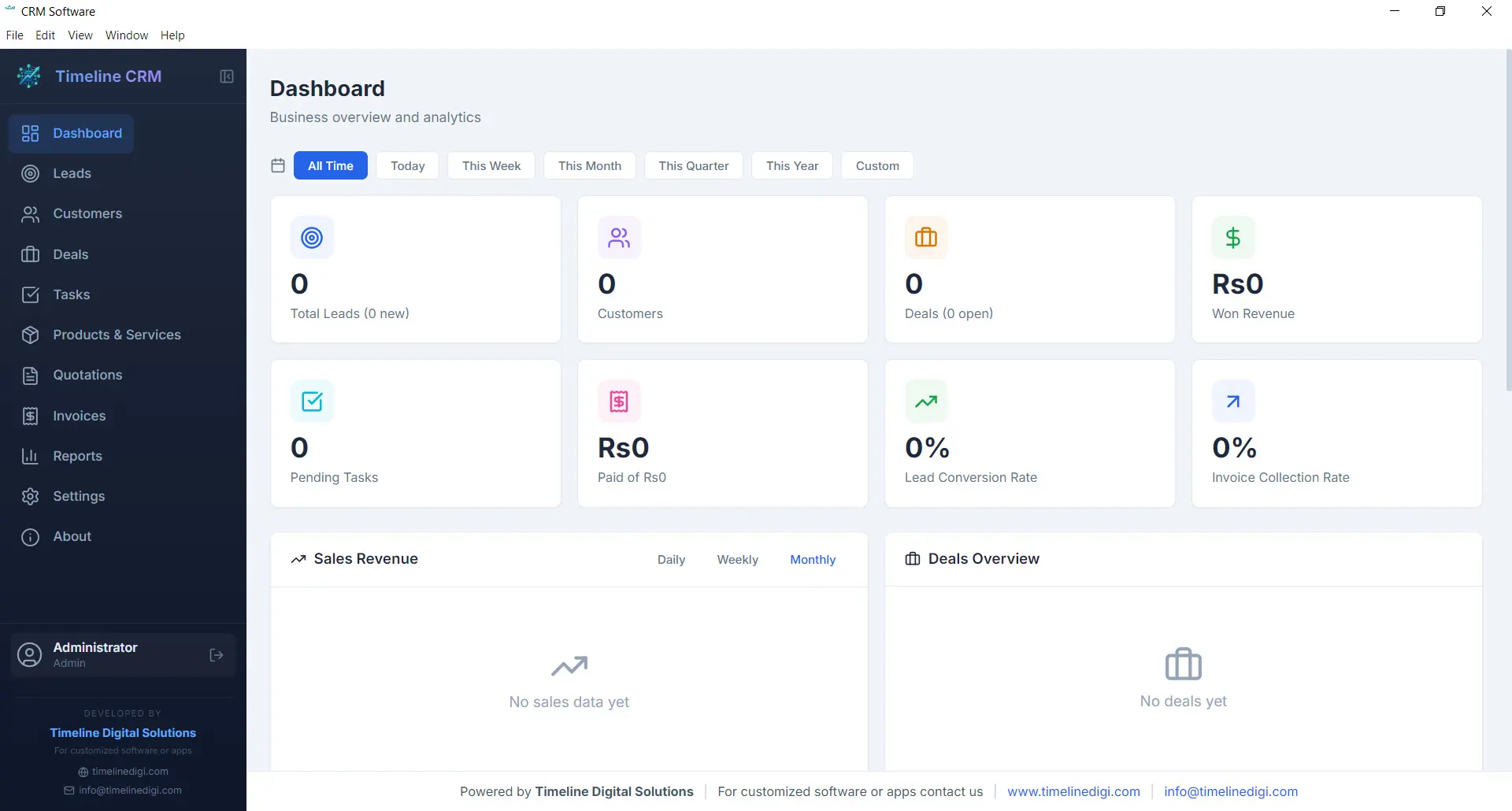
Dashboard
The Dashboard is your command center. Every time you open Timeline CRM, you are greeted with a comprehensive overview of your business performance. Key metrics are displayed prominently so you can gauge the health of your sales pipeline, track revenue trends, and identify areas that need attention — all without clicking through multiple screens.
Visual charts and summary cards present your data in an easy-to-digest format. Whether you want to see how many new leads came in this week, what your total deal value looks like, or which tasks are overdue, the Dashboard surfaces that information instantly. It is the first thing you see and the fastest way to stay on top of your business.
- Real-time business metrics and KPI cards
- Sales pipeline distribution chart
- Recent activity feed and upcoming tasks
- Revenue and lead trend visualizations
Leads
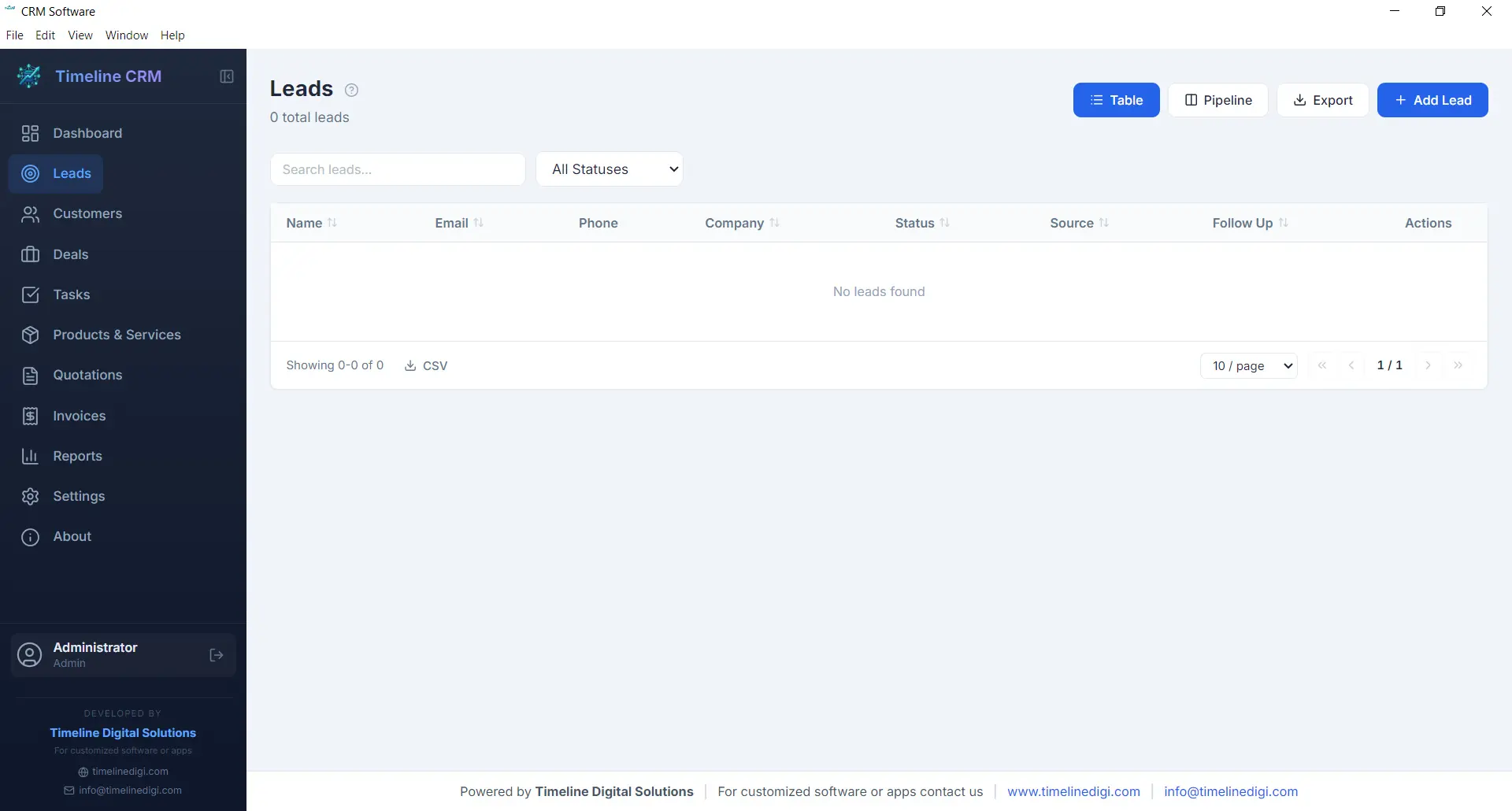
The Leads module is where every potential customer relationship begins. Capture new leads with detailed contact information, company details, and source tracking. Each lead is placed into a structured seven-stage pipeline — New, Contacted, Qualified, Proposal, Negotiation, Won, and Lost — so you always know exactly where every prospect stands in your sales process.
As you work with each lead, you can log phone calls, record meeting notes, attach documents, and track every interaction. This complete history ensures that no context is lost when you follow up days or weeks later. The pipeline view gives you a visual representation of your entire lead funnel, making it easy to spot bottlenecks and prioritize your outreach efforts.
- Seven-stage pipeline: New, Contacted, Qualified, Proposal, Negotiation, Won, Lost
- Call logging with date, duration, and notes
- Lead source and priority tracking
- Convert leads to customers with one click
Customers
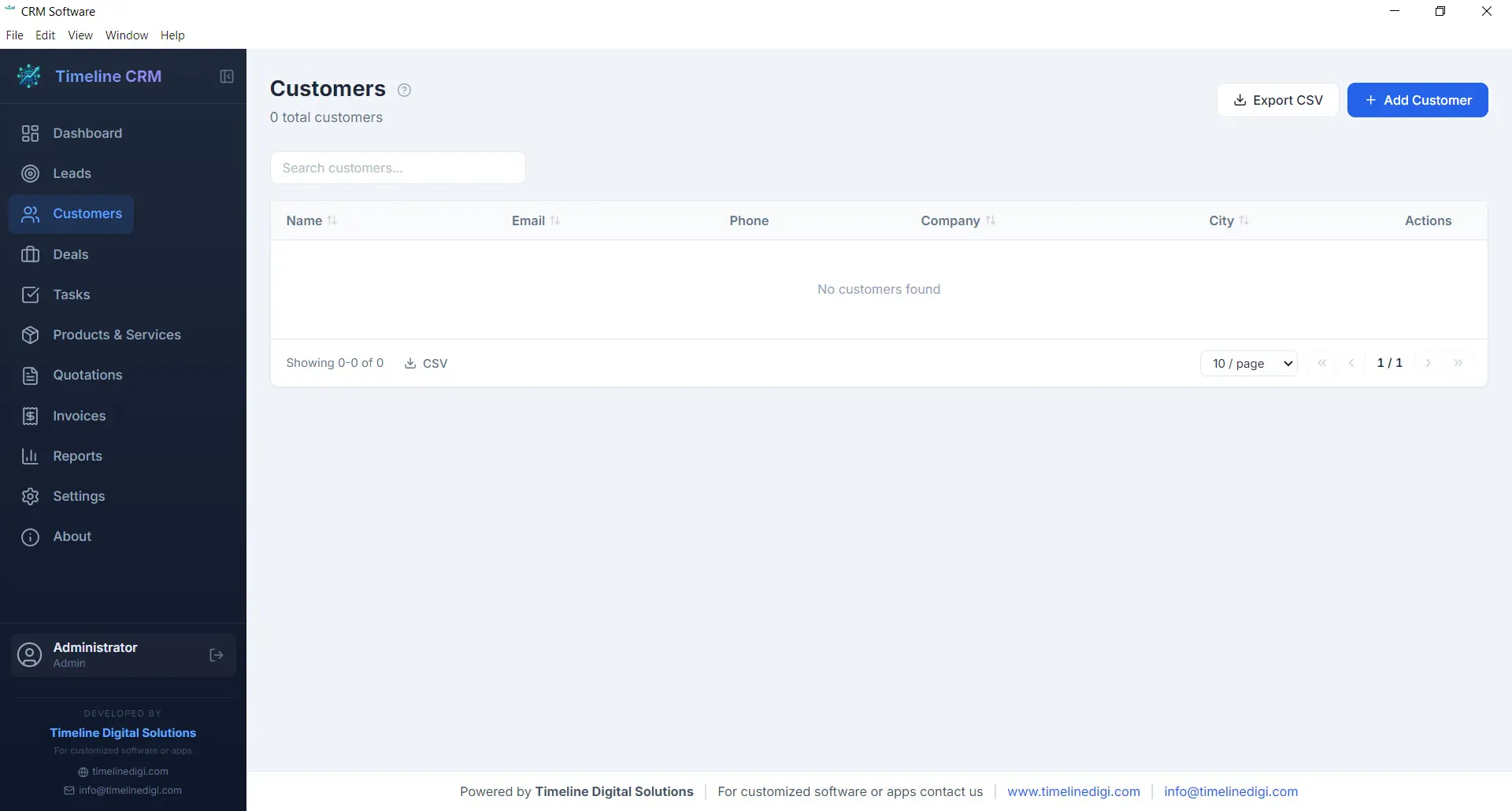
Your customers are the backbone of your business, and the Customers module helps you manage every relationship with care. Store comprehensive contact information, company details, billing addresses, and communication preferences in one organized record. When a lead is converted to a customer, all their history transfers automatically so nothing is lost in the transition.
Each customer profile acts as a hub connecting all related business data. Open any customer record and you can instantly view their associated deals, outstanding invoices, past quotations, and every note or interaction logged over time. This 360-degree view enables you to provide better service, anticipate needs, and build long-term relationships that drive repeat business.
- Complete contact and company profiles
- Full interaction and transaction history
- Linked deals, invoices, and quotations
- CSV export for customer data
Deals
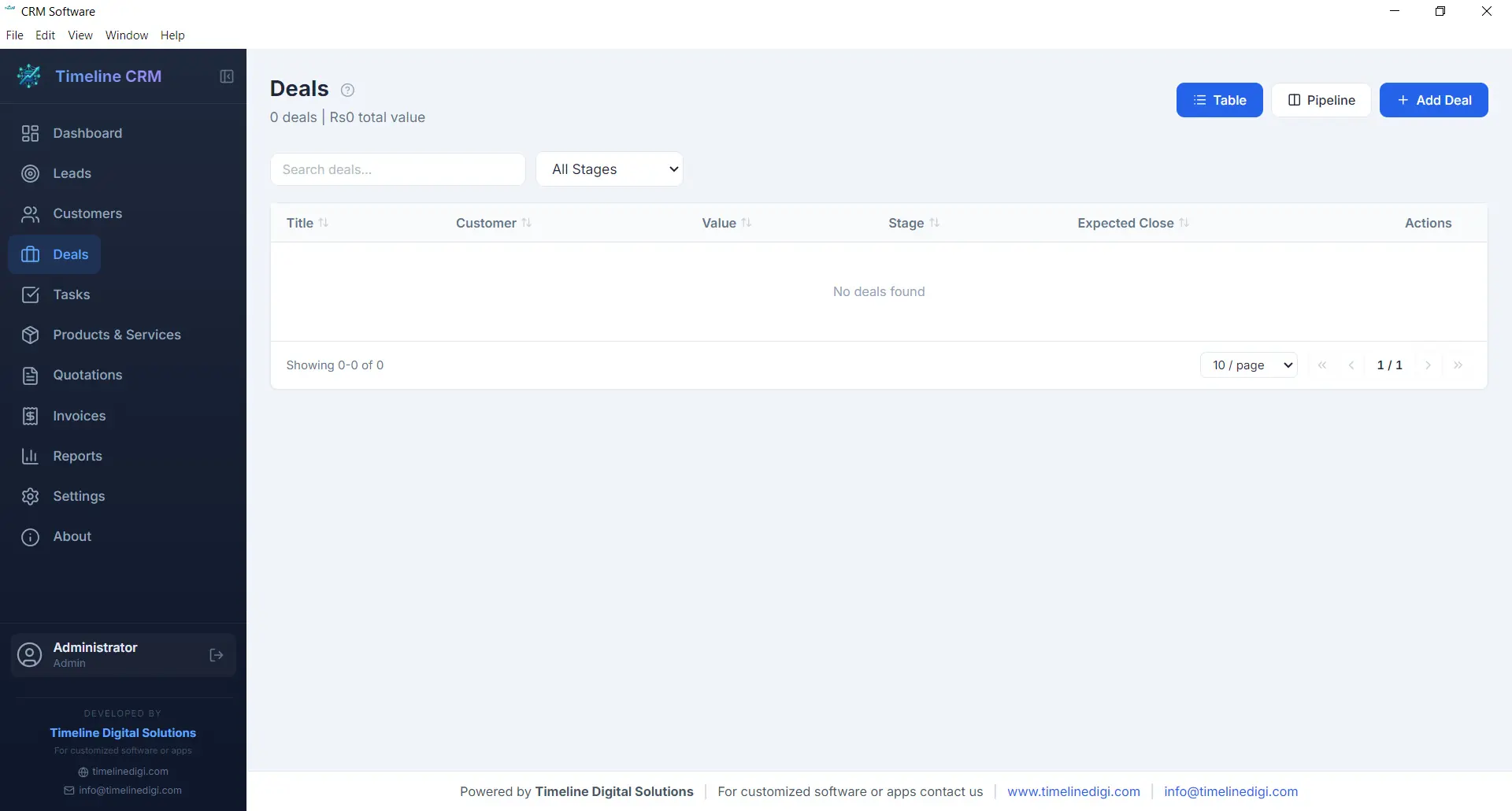
The Deals module tracks every sales opportunity from first conversation to closed contract. Each deal is assigned a monetary value, an expected close date, and a probability percentage, giving you accurate revenue forecasting at all times. The six-stage pipeline — Prospect, Qualification, Proposal, Negotiation, Won, and Lost — provides a clear visual workflow that keeps your sales process structured and predictable.
Deals are linked to specific customers and can reference related quotations, making it easy to track the progression from initial quote to final agreement. You can add notes, update stages with a single click, and monitor your weighted pipeline value to understand projected revenue. For business owners who need clarity on what money is coming in and when, the Deals module delivers that visibility.
- Six-stage pipeline: Prospect, Qualification, Proposal, Negotiation, Won, Lost
- Deal value, probability, and expected close date
- Revenue forecasting with weighted pipeline
- Linked to customers and quotations
Tasks
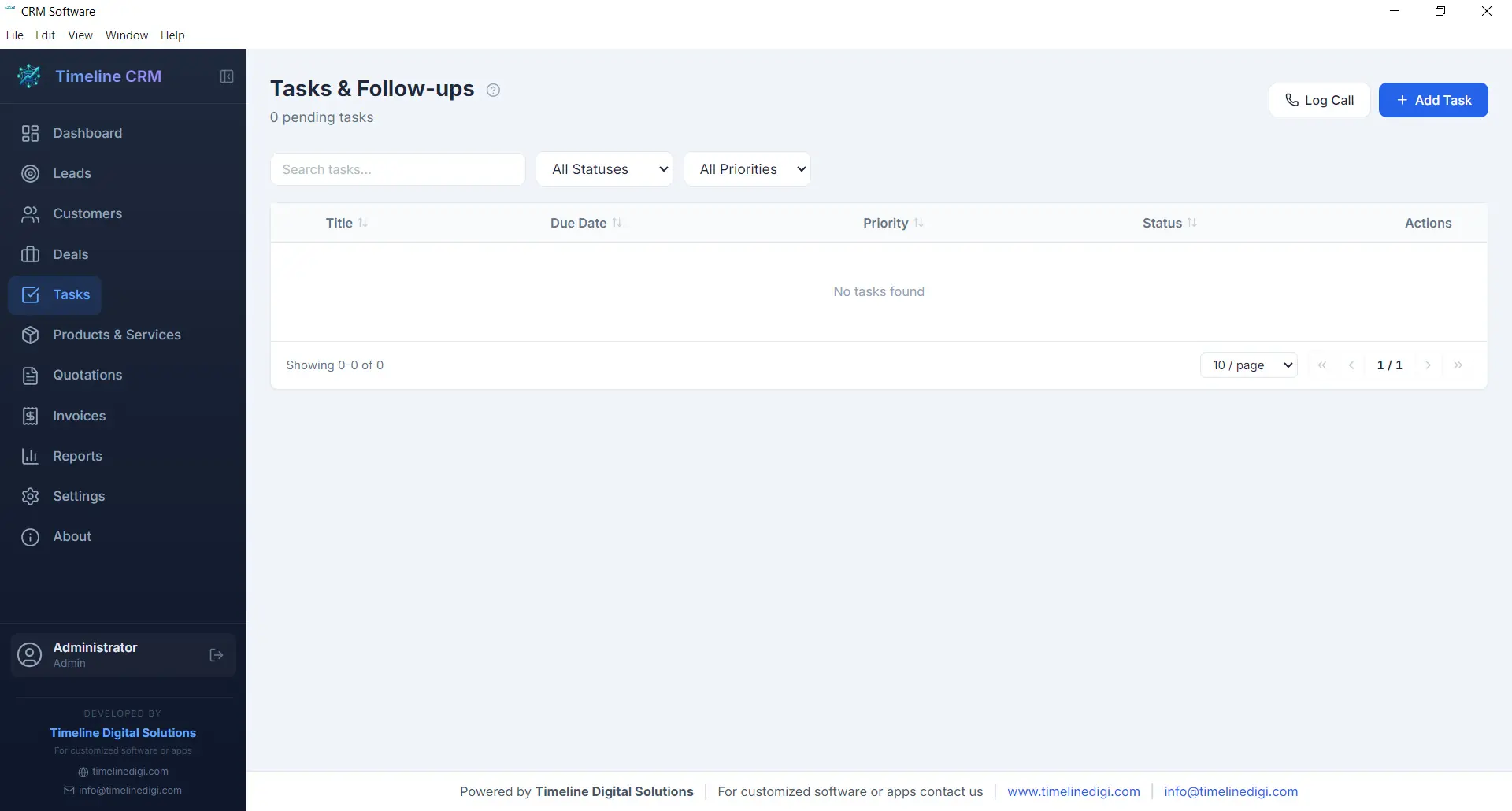
Staying organized is essential when you are managing multiple leads and deals simultaneously. The Tasks module gives you a straightforward way to create, prioritize, and track action items that keep your business moving forward. Each task can include a title, description, due date, priority level, and status, making it easy to see what needs attention right now.
Tasks can be linked to specific leads, customers, or deals, providing context about why the task exists and what it relates to. Whether you need to follow up with a prospect, prepare a proposal, or review an invoice, the Tasks module ensures nothing slips through the cracks. Overdue tasks are highlighted on the Dashboard so you can take action before opportunities are missed.
- Create tasks with due dates and priority levels
- Link tasks to leads, customers, or deals
- Status tracking: pending, in progress, completed
- Overdue task alerts on the Dashboard
Products
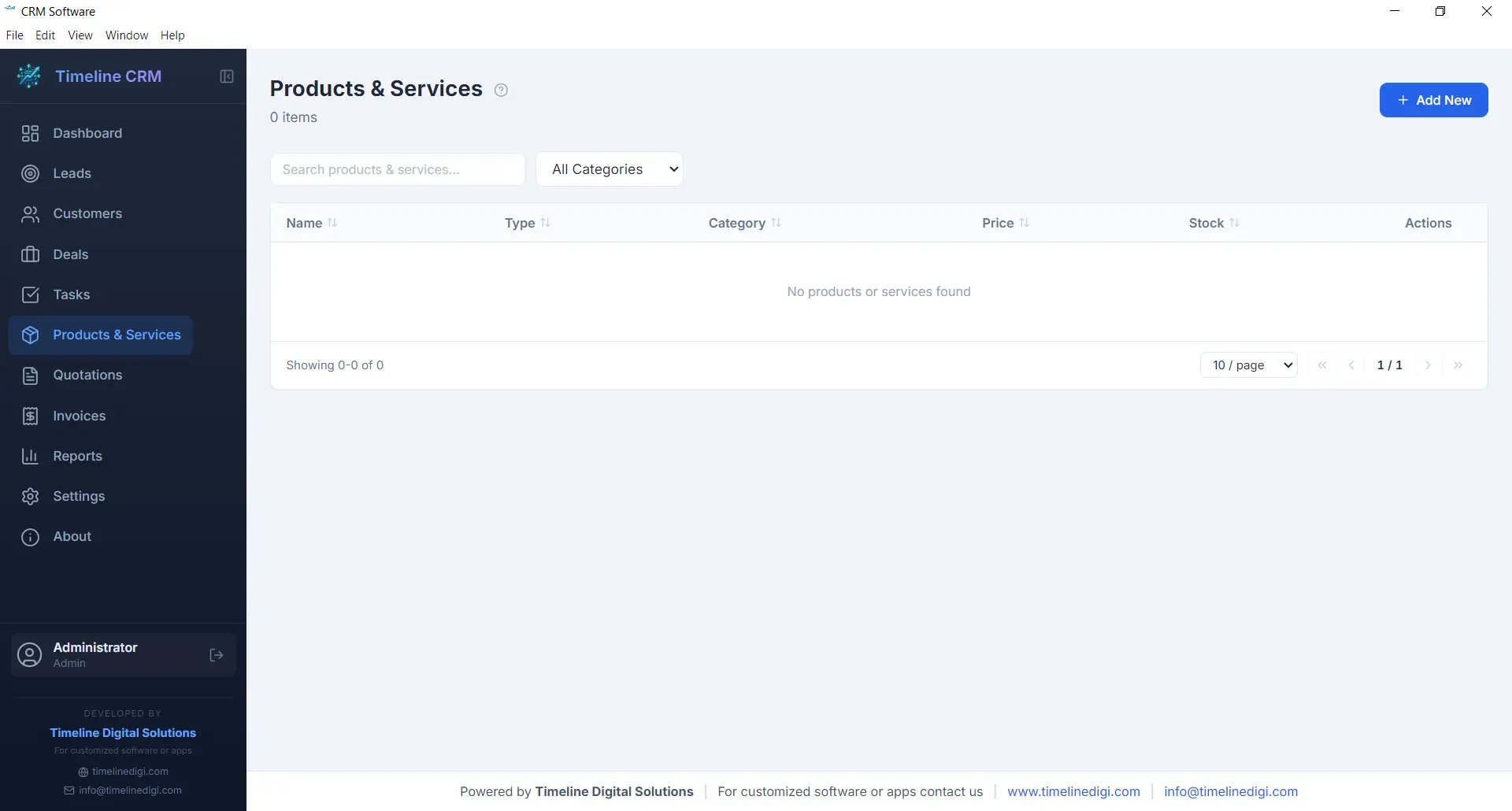
The Products module serves as your centralized catalog for everything your business sells, whether physical products, services, or subscription packages. Each product entry includes a name, description, unit price, and category, allowing you to build a well-organized inventory that feeds directly into your quotations and invoices.
Having a product catalog eliminates the repetitive task of manually entering item details every time you create a new quotation or invoice. Simply select products from your catalog, specify quantities, and the system handles the rest — including price calculations and line item formatting. This saves time, reduces errors, and ensures consistency across all your business documents.
- Centralized product and service catalog
- Name, description, price, and category fields
- Direct integration with quotations and invoices
- Unlimited product entries
Quotations
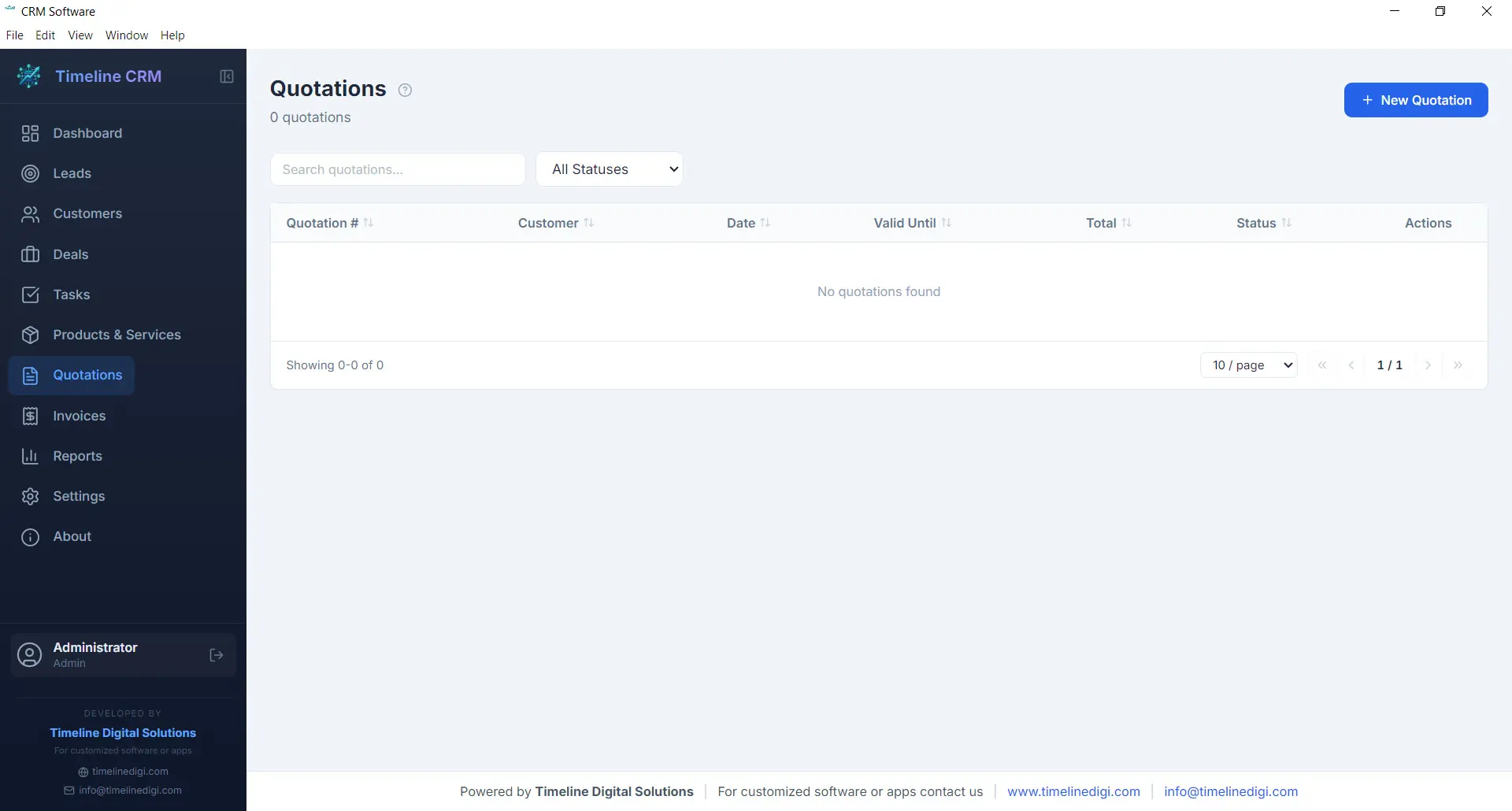
When a prospect is ready to hear your pricing, the Quotations module helps you respond quickly with a professional, branded document. Create quotations by selecting a customer, adding line items from your product catalog, adjusting quantities and pricing as needed, and generating a polished PDF in seconds. Auto-numbering ensures every quotation has a unique reference number for easy tracking.
Each quotation records the creation date, validity period, total amount, and current status. You can track whether a quote is pending, accepted, or rejected, giving you clear visibility into your conversion rates. Quotations can be linked to specific deals, so when a prospect accepts your quote, you can update the deal stage and move seamlessly toward closing the sale.
- Professional PDF quotation generation
- Auto-numbering with customizable prefix
- Line items from product catalog with quantity and pricing
- Status tracking: pending, accepted, rejected
Invoices
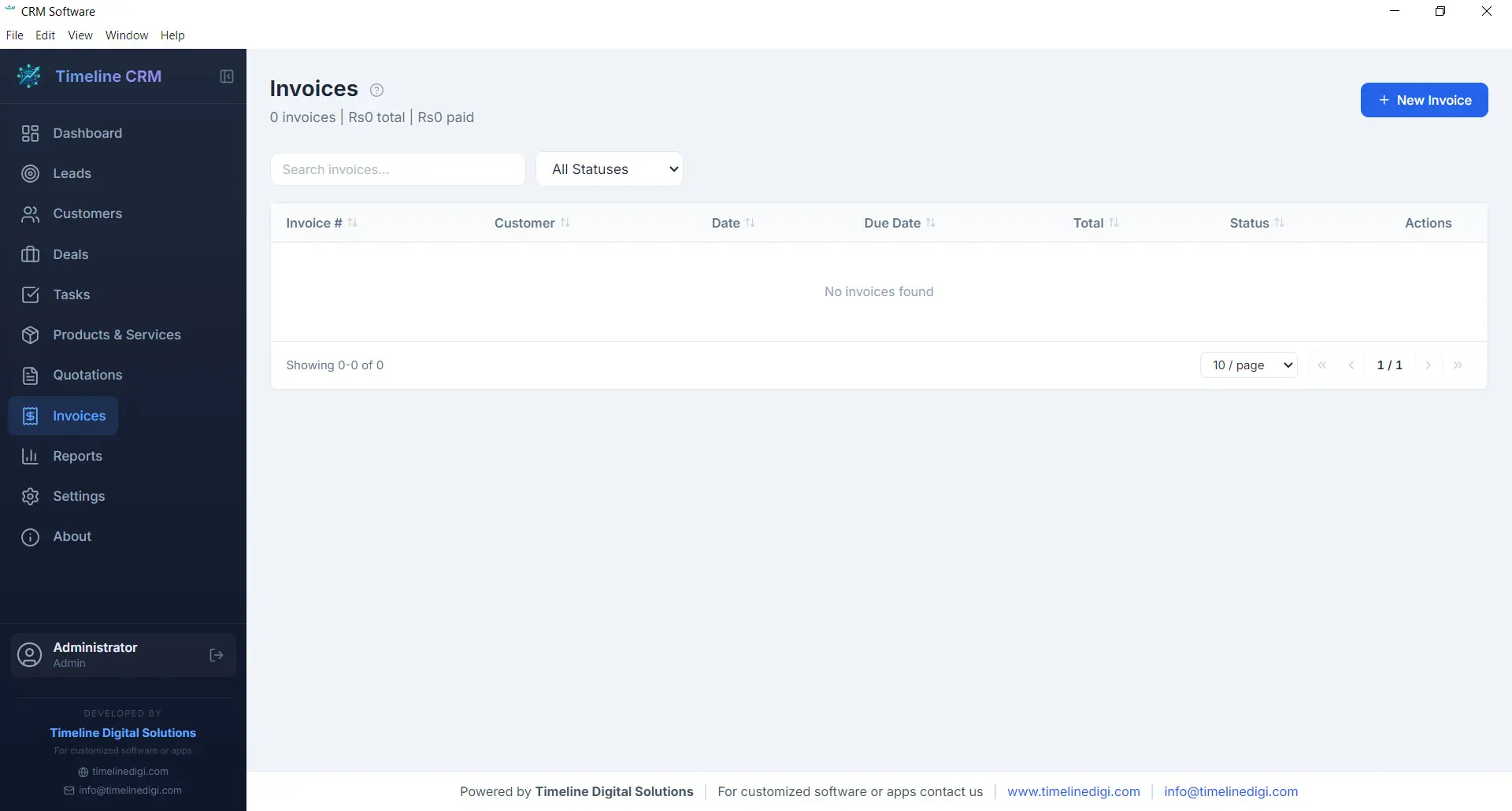
The Invoices module streamlines your billing workflow from creation to payment tracking. Generate detailed invoices with line items pulled from your product catalog, automatic tax calculations based on your configured rates, and professional formatting that represents your business well. Every invoice receives a unique auto-generated number for organized record keeping.
Track the payment status of each invoice — whether it is unpaid, partially paid, or fully settled — so you always know where your receivables stand. Export invoices as PDF documents to share with customers via email or print. The invoicing module works hand-in-hand with your customer and deal records, keeping your financial data connected to the rest of your business operations.
- PDF invoice generation with professional formatting
- Automatic tax calculations
- Payment status tracking: unpaid, partial, paid
- Auto-numbering with customizable prefix
Reports
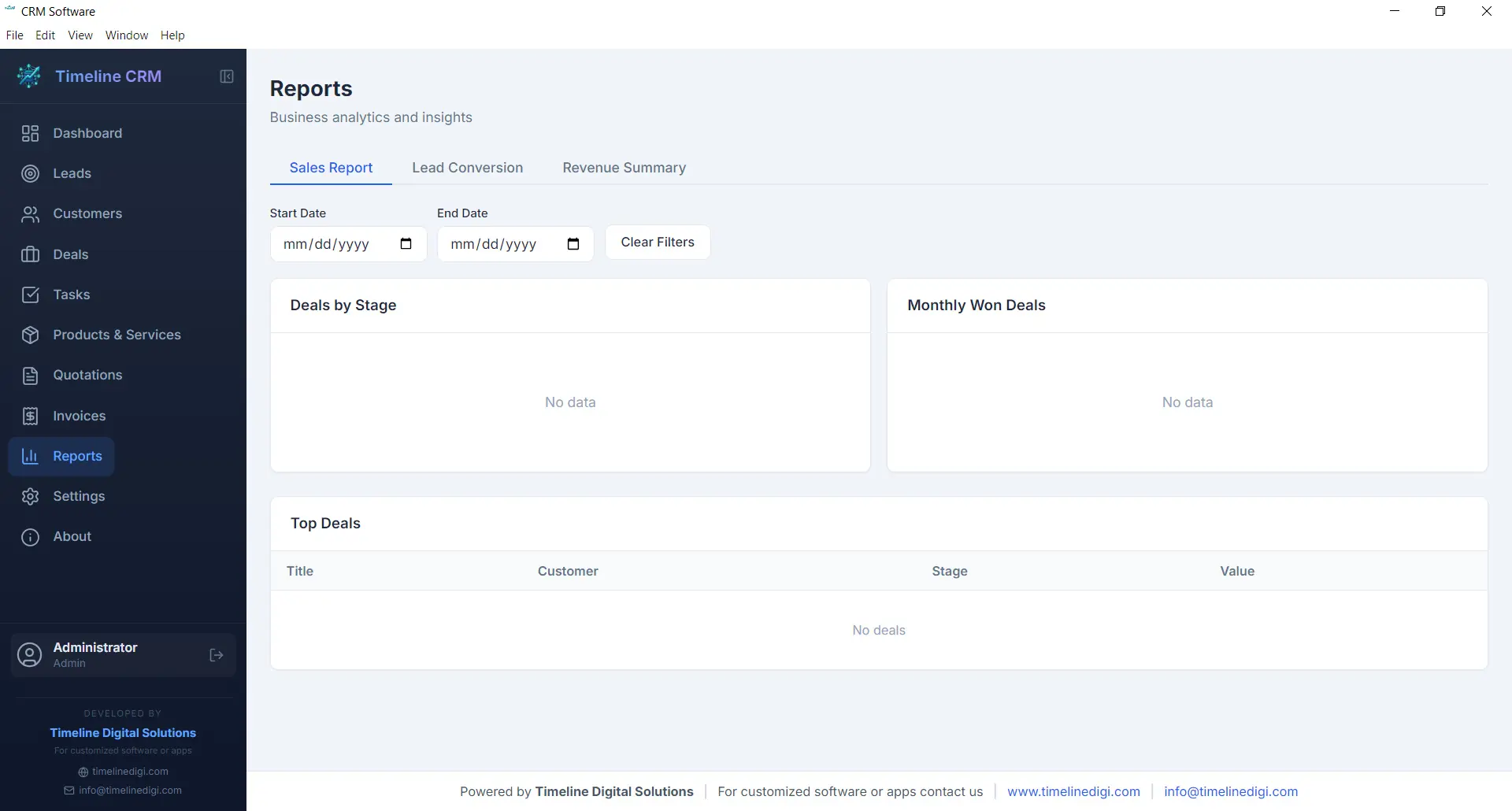
Data-driven decisions lead to better outcomes, and the Reports module gives you the insights you need without requiring a data analyst. Generate reports on sales performance, lead conversion rates, revenue trends, and pipeline health. Each report presents your data in clear, readable formats that help you understand what is working and what needs improvement.
Reports can be exported as CSV files for further analysis in spreadsheet applications or for sharing with business partners and accountants. Whether you need a monthly sales summary, a breakdown of deals by stage, or an overview of your lead sources, the Reports module produces the numbers you need to steer your business confidently.
- Sales performance and revenue reports
- Lead conversion and pipeline analysis
- CSV export for external analysis
- Visual charts and data summaries
Settings
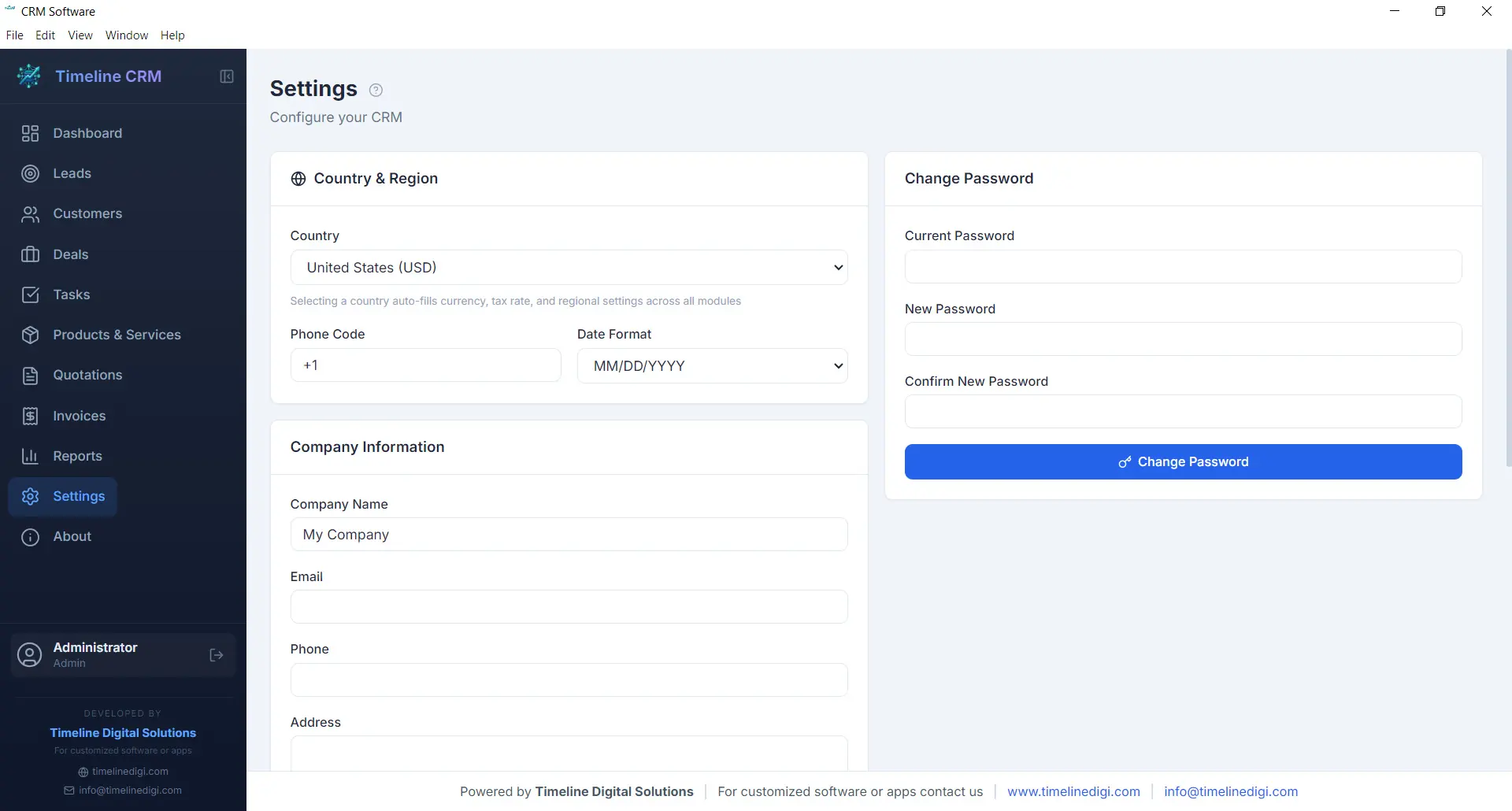
Every business has unique requirements, and the Settings module lets you tailor Timeline CRM to match yours. Configure your company name, logo, address, and contact details so that all generated documents — quotations and invoices — carry your branding. Set your preferred currency, tax rates, and country-based formatting to ensure financial calculations and number formats are correct for your region.
Customize auto-numbering prefixes for quotations and invoices to match your existing document numbering scheme. Adjust date formats, language preferences, and other display options to create a workspace that feels familiar and efficient. The Settings module is designed to be configured once and then work seamlessly in the background as you use every other module.
- Company profile and branding configuration
- Currency, tax, and country-based settings
- Auto-numbering prefix customization
- Date format and display preferences
Offline & Secure
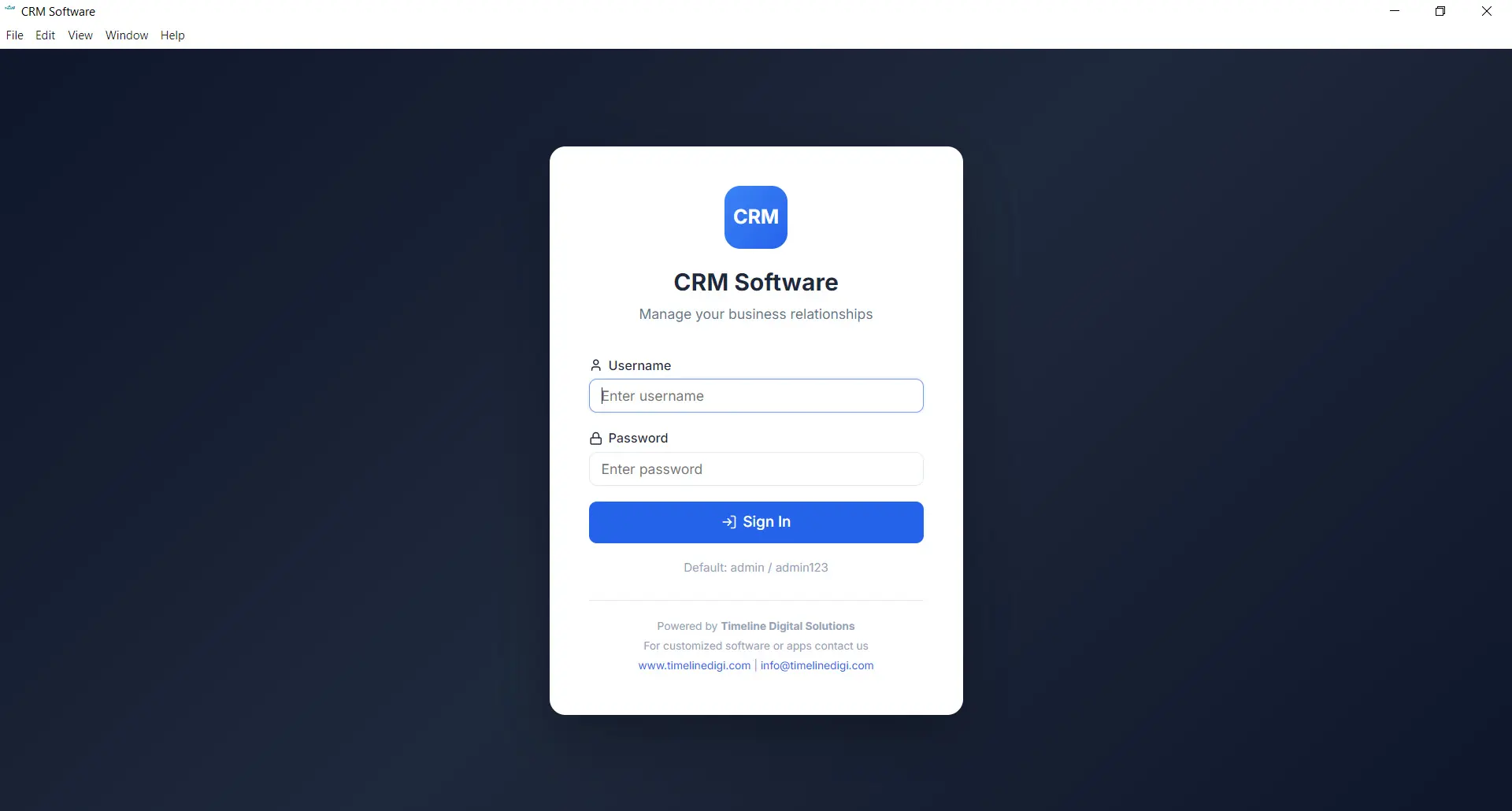
Privacy and data ownership are fundamental principles of Timeline CRM. Unlike cloud-based CRM systems that store your sensitive business data on third-party servers, Timeline CRM keeps everything on your local machine. The application uses SQLite as its database engine, storing all your leads, customers, deals, invoices, and other records in a single file on your hard drive that you fully control.
Because the application works entirely offline, you are never vulnerable to server outages, internet disruptions, or subscription cancellations that could lock you out of your own data. Your business information is always accessible, always private, and always yours. Back up your data by simply copying the database file, and rest assured that no one else has access to your customer information.
- 100% local data storage using SQLite
- No internet connection required
- No third-party data access or sharing
- Simple file-based backup and portability
All These Features. Completely Free.
Every module, every feature, every capability described above is included at no cost. Download Timeline CRM and start using all eleven modules today — no trial period, no feature restrictions, no credit card required.
Download Timeline CRM FreeVersion 1.0.0 • Windows 10/11 • 64-bit
See Timeline CRM in Action
Timeline CRM helps businesses manage leads, contacts, deals, quotations, invoices, and follow-ups in one place. Explore core workflows and compare related guides to choose the best setup for your team.